How to Tell If Food Has Gone Off and When to Throw It Away

You open the fridge, look at a product and the question comes up: is this still fine or not?
It is one of those everyday moments where it is easy to get it wrong in both directions.
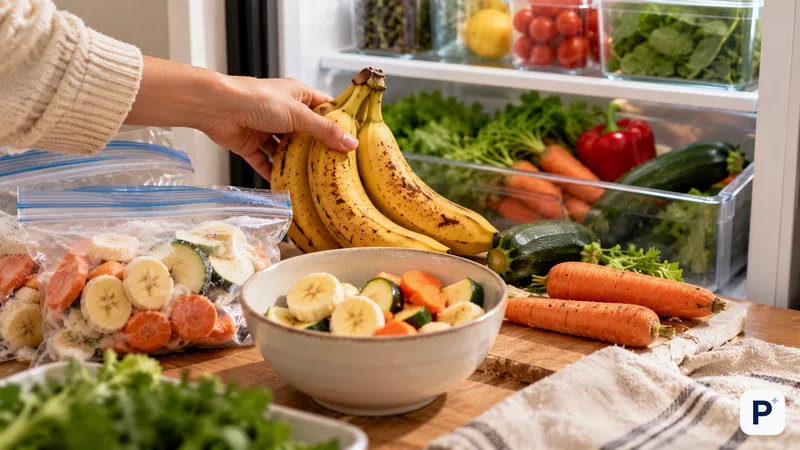
You might throw away food that has only lost its perfect freshness. A limp carrot can still go into soup, stale bread into toast, and a very ripe banana into pancakes.
You might also do the opposite and treat a product as safe simply because it "doesn't smell off yet". That is a far more serious mistake, because disease-causing bacteria do not always change the taste, appearance or smell of food. Food-safety authorities state plainly that food can cause illness despite looking and smelling completely normal.
That is why it is worth separating two questions: Has the product lost quality? and Could the product be unsafe? These are not always the same thing.
We cover what "use by" and "best before" mean in a separate guide on how to read date labels. Here we deal with what you actually see once you have opened the fridge, the packaging or the container.
Losing freshness is not the same as going off
Not every food that has stopped looking perfect belongs in the bin. Vegetables can wilt because they lose water. Bread goes stale as the structure of the starch changes and it loses moisture. A banana turns brown as it ripens. Cheese can dry out on the surface. Chocolate can develop a pale fat or sugar bloom.
Such changes often mean a decline in quality rather than an automatic danger.
A limp carrot can go into soup or sauce. Soft, very ripe bananas work well in porridge, cake or pancakes. Stale but mould-free bread can become croutons, toast or breadcrumbs. Vegetables that have lost their firmness are often still fine for cooking, as long as they have no slime, mould, rot or other signs of spoilage.
So the key difference is this: a worse texture does not always mean the food has gone off. But there are signals at which point we no longer try to save a product.
Mould: when you can cut it off and when to bin the lot
There is no single rule here that covers all food. Whether you can remove a mouldy piece depends above all on the structure of the product. In moist, porous food, mould can spread far deeper than the visible spot on the surface. Food-safety authorities distinguish several specific categories.
| Food with mould | What to do |
|---|---|
| Hard cheese, e.g. cheddar or a hard matured cheese | You can cut away a minimum of about 2.5 cm around and below the mould |
| Firm, hard vegetables and fruit, e.g. carrot, cabbage, pepper | A small patch can be cut out with a margin of about 2.5 cm |
| Soft cheese, curd cheese, cream cheese | Throw the whole thing away |
| Grated, sliced or crumbled cheese | Throw the whole thing away |
| Yoghurt and cream | Throw the whole thing away |
| Bread and baked goods | Throw the whole thing away |
| Jam and jelly | Throw the whole thing away |
| Cooked pasta and grains | Throw the whole thing away |
| Ready meals and bakes | Throw the whole thing away |
| Cold cuts, frankfurters, bacon | Throw the whole thing away |
| Soft fruit and vegetables | Throw the whole thing away |
| Nuts and peanut butter | Throw the whole thing away |
With hard cheese or a firm vegetable, scraping off the coloured spot alone is not enough. Food-safety authorities recommend cutting away at least an inch, that is about 2.5 cm, both around the patch and beneath it. The knife should not touch the mould, so that it is not transferred to the part of the product you keep.
An important exception is cheeses in which mould is a deliberate part of the production process, for example blue cheeses, Brie or Camembert. Here you need to tell the proper mould characteristic of a particular cheese from a new, unusual change. A soft Brie or Camembert with mould other than the kind that comes from its production should be thrown away.
Why cutting off the green piece of bread is not enough
What you see on the surface does not show the full reach of the mould. In porous products its structures can go deeper, even though all you can see with the naked eye is a small spot. That is exactly why it is not worth cutting off one slice and keeping the rest of the loaf.
If bread is mouldy, throw the whole thing away.
The toaster will not help either. You cannot assume that heating a mouldy product removes the danger. Some moulds can produce mycotoxins, that is toxic compounds. Food-safety authorities note that most mycotoxins are chemically stable and can survive food processing.
So: baking, frying or reheating is not a way to "save" mouldy food. Do not make croutons from such bread. Do not cook mouldy fruit into a compote. Do not scrape mould off jam.
Do not sniff a mouldy product up close
The natural instinct is to bring food up to your nose to check whether it smells bad. With visible mould it is better not to do this.
Food-safety authorities advise that you should not sniff mouldy food directly, because it can cause breathing problems in some people. If you can already see the mould, an extra smell test adds nothing useful.
Meat: colour alone is not enough
With meat it is especially easy to judge the product by its colour. The beef has turned brown, so it has gone off. The chicken is no longer as pink, so it has to be thrown away. Not always.
Food-safety authorities explain that a change in colour alone can result from normal changes in the meat's pigment and contact with oxygen. Vacuum-packed beef can have a purple tinge, turn bright red on contact with the air, and later go brown as it oxidises. Colour on its own is not a sufficient test of spoilage.
Far more worrying is a combination of several changes:
- an unpleasant smell,
- a sticky or tacky surface,
- a slimy texture,
- a clear decline in appearance.
Food-safety authorities point precisely to smell and a sticky, tacky or slimy surface as characteristic signs that meat and poultry are spoiling. If such signals are present, do not use the product.
At the same time, remember: a normal smell does not extend the date on meat. What still counts is the "use by" date, the temperature and how long the product has been in the fridge. You will find more about these rules in our guide on how to store meat, fish and cold cuts.
How to tell when fish has lost its freshness
Fresh fish should have a mild, fresh smell, not a strongly fishy, sour, rancid or ammonia-like one.
Food-safety authorities also point to firm flesh that springs back to its shape when pressed. With a whole fish, the eyes should be clear and shiny. The warning signs are therefore above all:
- a sharp sour or ammonia-like smell,
- a clearly slimy surface,
- a falling-apart texture,
- unusual changes combined with other signs of spoilage.
Food-safety authorities add that the colour of fish is also not a standalone indicator of freshness, because it can depend on many factors. If fish smells sour, rancid, strongly fishy or of ammonia, do not eat it.
Bulging packaging needs attention
With packaged products you are not judging the food alone. Check the packaging too.
A tin that is bulging, leaking, deeply damaged or looks different from how it should is not a product for "tasting and seeing". Food-safety authorities recommend throwing away tins that are bulging, leaking, holed or seriously damaged.
Treat in the same way an unusually inflated pack of a chilled product that should not normally be filled with gas, especially if it comes with a change in smell, texture or a leak.
This does not, of course, apply to packaging that is designed to have a particular shape or is packed in a protective atmosphere. What counts is an unusual change compared with the normal packaging of that product.
Dairy: separate normal changes from genuine spoilage
With dairy it is easy to confuse the natural features of a product with signs of spoilage.
A small amount of liquid can appear on the surface of yoghurt. This is often simply whey that has naturally separated from the rest of the product. You can stir it back in. Yoghurt, kefir and buttermilk are also sour by nature, so a "sour taste" on its own is not a useful criterion.
It is a different matter when a product has clearly changed from its normal form. Mould on yoghurt or cream means throwing away the whole pot. Do not just take off the top layer. Food-safety authorities class both products as high-moisture foods, in which contamination can lie below the visible surface.
Treat in the same way:
- an unusual, off-putting smell,
- unexpected gassing or an inflated pack,
- mould,
- a clear change in texture that the product does not normally have.
Do not taste suspect dairy in order to check whether it is fine. With a product carrying a "use by" date, do not use the smell test either as a way to extend the date.
Cheese: hard and soft call for two different rules
This is one of the most practical exceptions. If a small patch of mould unrelated to the production process appears on a firm piece of hard cheese, for example cheddar, food-safety authorities allow cutting off about 2.5 cm around and into the patch.
If mould appears on:
- curd cheese,
- cream cheese,
- soft cheese,
- grated cheese,
- sliced cheese,
- crumbled cheese,
throw the whole thing away. In these products mould can spread far beyond the visible spot. That is why the "I'll cut it off and it will be fine" rule applies to a much smaller group of cheeses than it might seem.
An egg floats? That is still not a safety test
The popular test involves putting an egg into a glass of water. A fresher one lies on the bottom, an older one starts to float. The mechanism is real: over time the air cell inside the egg grows, so its buoyancy increases.
But it does not follow that "floats = gone off" or "sinks = definitely safe". Food-safety authorities explain that a floating egg is older and of lower quality, but may still be safe.
If an egg raises doubts, crack it separately into a small bowl, not straight into a whole cake mix or a pan with five other eggs. A bad egg usually has a very clear unpleasant smell once cracked.
And if the shell was already cracked at the time of purchase, do not use that egg. Bacteria can get inside through the crack.
Bread: save it stale, bin it mouldy
This is a good example of the difference between a decline in quality and going off. Stale bread without mould does not have to go in the bin. You can turn it into:
- fried bread,
- toast,
- bakes,
- breadcrumbs,
- croutons for soup.
But if mould appears, the situation changes completely. Do not cut off one slice. Do not pull out the green piece. Do not put the rest in the toaster. Food-safety authorities recommend throwing away all bread and baked goods, because their porous structure lets mould develop beneath the surface.
You will find more ways to keep bread fresh for longer in our guide on how to store bread.
Fruit and vegetables: soft does not automatically mean gone off
A banana with a brown skin has not gone off just because it no longer looks like one from an advert. A carrot can wilt. A pepper can lose a little firmness. A tomato can turn very soft.
First look for signs of actual rot, mould, slime, an unusual smell or a falling-apart structure. If a product has only lost its firmness, you can often still use it in a dish where texture no longer matters. A soft tomato can go into sauce. A limp carrot into soup. A very ripe banana into cake.
But a mouldy soft fruit or vegetable should be thrown away whole. Food-safety authorities give peaches, tomatoes and cucumbers among the examples.
A small surface patch on a really firm product, such as carrot, cabbage or pepper, can be treated differently. In that case you can cut out the mould with a generous margin of about 2.5 cm.
Do not try to save mouldy nuts
With nuts the natural instinct may be to pick out the mouldy ones and keep the rest. This is a product where it is worth being more cautious.
Food-safety authorities recommend throwing away mouldy nuts and peanut butter. They also point out that nuts are one of the categories particularly prone to certain mycotoxins, including aflatoxins, and advise discarding any that are mouldy, discoloured or clearly damaged.
A separate problem is going rancid. A nut may have no mould, but its fat oxidises over time. A characteristic stale, bitter, paint-like or clearly unpleasant smell and taste mean a decline in quality.
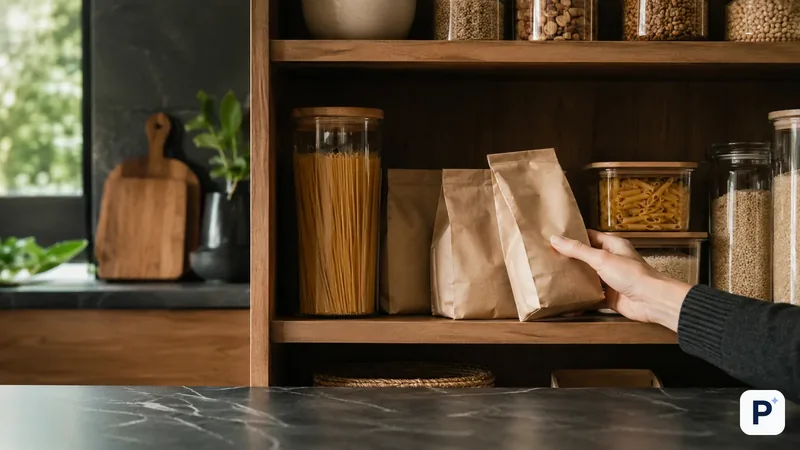
That is why it is worth storing nuts, pips and seeds somewhere cooler than pasta or white rice, especially if you buy larger packs.
Dry products spoil differently from fresh ones
With rice, pasta, flour and groats the main problem is usually not being a few days past the date. You are looking above all for:
- mould,
- moisture,
- a musty smell,
- pests,
- larvae,
- webbing,
- unusual lumps,
- a rancid smell in products containing more fat.
Most such products carry a "best before" marking, that is a date relating above all to keeping quality. So do not automatically throw away dry pasta just because the minimum durability date passed yesterday.
You will find more about storing this group in our guide on how to store flour, rice, groats and other dry products.
Smell only works in one direction
This is probably the most important rule in the whole article.
If a product clearly smells bad or looks like it has gone off, do not eat it. But: if it smells normal, that does not automatically mean it is safe.
The bacteria responsible for spoiling food often change its smell, taste and appearance. Disease-causing bacteria may not do so at all. Food-safety authorities clearly separate these two phenomena: the micro-organisms that cause visible spoilage are not the same as the pathogens that cause food poisoning.
That is why, with perishable food, you need to take into account not only your senses but also:
- the storage time,
- the temperature,
- the "use by" date,
- the time spent out of the fridge,
- the way it was prepared and cooled.
A good-smelling chicken that has sat on a warm worktop for half a day does not become safe just because your nose has not picked up anything suspicious.
Do not taste a product to check whether it is fine
"I'll try a bit and see" is not a good safety test. If a product raises a genuine suspicion that it has gone off, you do not need to taste it to make a decision.
This applies especially to meat, fish, ready meals, dairy and food whose storage history you do not know.
We use our senses to notice quality and obvious changes. We do not use them to prove that a product is definitely safe.
When it really is better to throw it away
With food waste it is easy to overdo it in the other direction too and try to save everything. That is not the point.
If you do not know how long a perishable product has been out of the fridge, cannot remember how long it has been sitting there, the packaging is leaking, the food has mould in a category you must not try to save, or clear signs of spoilage have appeared, do not take the risk. Be especially careful with:
- raw and cooked meat,
- poultry,
- fish and seafood,
- dairy products,
- ready meals,
- egg dishes,
- dinner leftovers.
With these products the right temperature and timing matter more than the nose test. If you are unsure about a cooked dish, see also the table in our guide on how long you can keep cooked food in the fridge.
The best moment to save food is the day before
The easiest way to cut waste is not to become an expert in mouldy products. It is better to end up less often in a situation where you have to wonder: "can this still be eaten?"
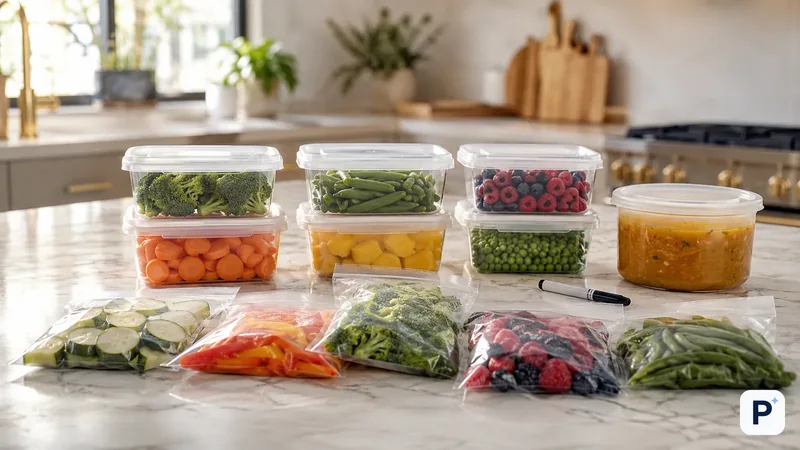
If you can see that a head of broccoli is starting to lose its freshness, use it today. If you know you will not eat the meat before its date, freeze it early. If you have half a pot of cream left, plan a dish to use it in. If bread is regularly left over, freeze part of the loaf straight away.
The biggest difference comes before a product goes off, not after mould has appeared. That is why it is worth having a simple "eat first" zone in the fridge, putting older products at the front and regularly checking what needs using up.
PantryOS helps you spot a product before a problem appears
Most food does not end up in the bin because we cannot tell mould from a fresh product.
First the product is bought. Then it is put away. Then it disappears behind other things. And by the time you find it again, it is already too late.