How to Store Meat, Fish and Cold Cuts to Keep Them Fresh for Longer
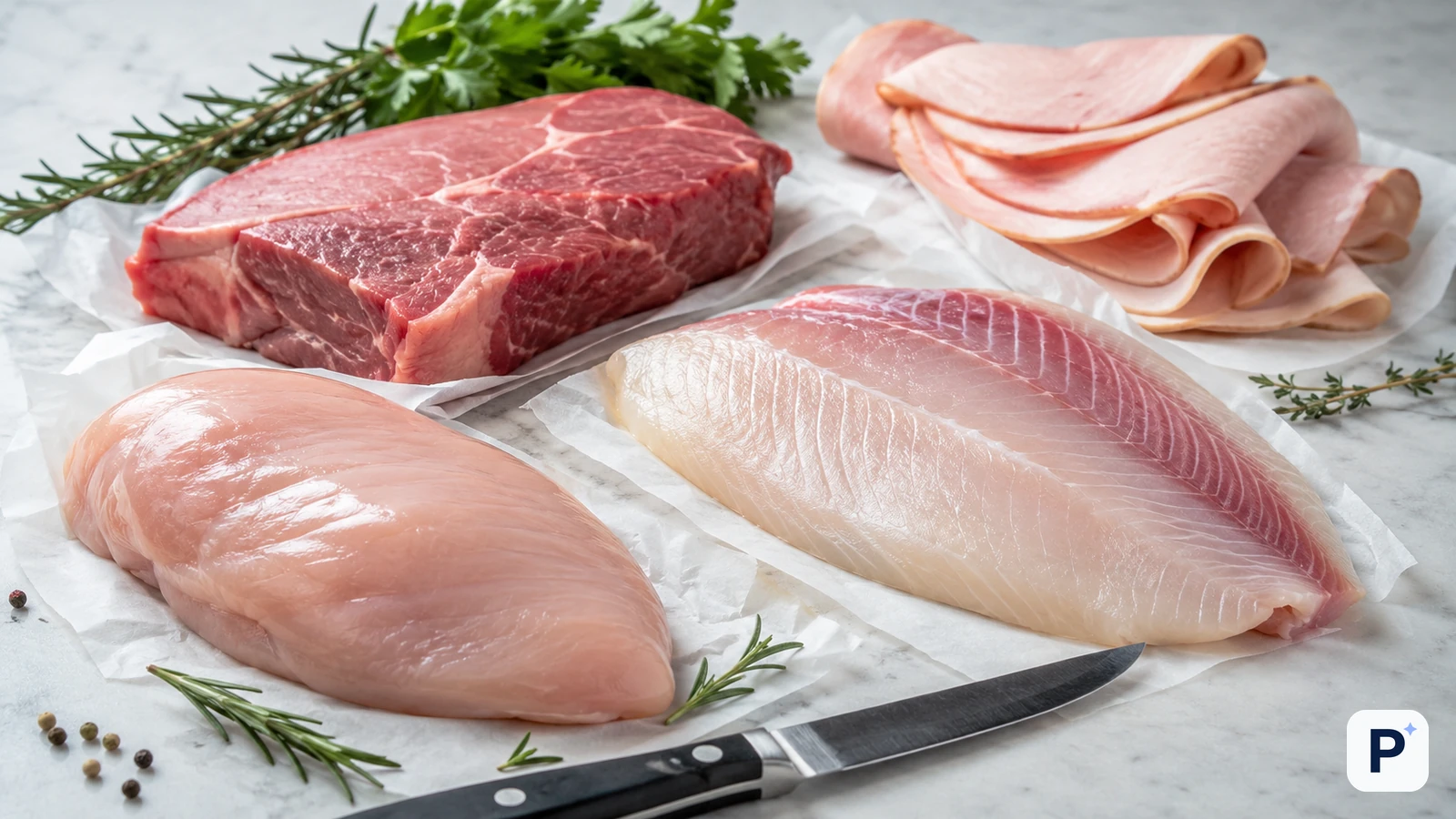
Meat, fish and cold cuts are among the foods where storage mistakes matter more than simply a loss of flavour or a few dollars thrown in the bin.
Raw meat and fish can carry disease-causing microorganisms that are easily transferred to your hands, a chopping board, the worktop or other food. In ready-to-eat products, such as some cold cuts or smoked fish, one of the things that matters is Listeria monocytogenes, which can also multiply at fridge temperatures.
That is why four things matter with this group of foods: temperature, time, keeping raw separate from cooked, and a quick decision to freeze whatever you won't manage to use.
This guide covers raw products. If you are interested in storage times for food that has already been cooked, see our separate article on how long you can keep cooked food.
This guide complements our series on storage, alongside articles on fruit and vegetables, dairy and eggs, bread and fresh herbs.
Keep Raw Meat and Fish on the Bottom Shelf of the Fridge
The most important reason is not simply "because the bottom is always the coldest".
Temperature distribution depends on how a particular fridge is built. In one, the coldest spot will be the bottom shelf; in another, it will be the zone the manufacturer marks as 0°C. That is why it is worth knowing the layout of your own appliance and, ideally, checking the temperature with a thermometer.
For safety, perishable food should be kept cold, and food-safety authorities recommend keeping the fridge below 5°C.
Still, keep raw meat, poultry and fish below ready-to-eat food. This matters even when the temperature on several shelves is similar.
If the meat packaging springs a leak, its juices should not drip onto the cooked dinner, cheese, cold cuts or vegetables that you will later eat without cooking. Official guidance specifically recommends storing raw meat on the bottom shelf, in a suitable container that catches any leaks.
The simplest layout:
- higher up: ready-to-eat products, cooked dishes, dairy and cold cuts,
- lower down: tightly sealed raw meat, poultry and fish.
Don't Open Factory-Sealed Meat Unnecessarily
If you bought meat in a sealed tray, vacuum packaging or a protective atmosphere, don't open it just to move it to another container and give it "air circulation".
The original, undamaged manufacturer's packaging can stay closed until you use it, in line with the instructions on the label.
It is, however, a good idea to place the whole package in an extra container or on a tray, especially on the bottom shelf. If something starts to leak, the liquid will stay in the container rather than spreading around the fridge.
Official guidance recommends storing raw meat, poultry and seafood in sealed containers or leak-proof bags that limit the chance of juices leaking onto other products.
If you buy meat loose from the butcher, transfer it to a clean, sealable container when you get home and put it in the fridge.
How Long Raw Meat Can Stay in the Fridge
Not all types of meat have the same storage time.
At a fridge temperature of around 4°C or lower, official food-safety guidance gives the following rough figures:
- raw poultry: 1–2 days,
- mince: 1–2 days,
- raw sausages: 1–2 days,
- steaks, chops and larger cuts of beef, pork, lamb and veal: 3–5 days.
These are rough guideline times for home storage. If the packaging shows an earlier "use by" date, that is the one you must follow.
So don't treat the rule "beef can sit for five days" as permission to ignore the label.
If you already know on the day of purchase that you won't use the meat in time, freeze it straight away. The freezer should be a plan, not a last-ditch attempt to rescue meat the day before its date runs out.
Don't Wash Raw Meat or Chicken
This is still a fairly common home habit, but it does not make things safer.
Washing chicken, meat or fish under the tap can splash water containing microorganisms onto the sink, worktop, dishes and nearby products.
Official guidance recommends that you do not rinse raw meat and poultry before cooking. Microorganisms are removed by proper cooking, not by tap water.
After handling raw meat, do wash your hands, the knife, the chopping board and all the surfaces it touched thoroughly.
Fish Calls for a Particularly Quick Decision
Fresh fish is one of the most perishable categories of food.
Official food-safety guidance gives fresh fish around 1–3 days in the fridge, depending on the species and storage conditions.
In practice, the sooner you prepare fresh fish, the better for its quality. If you buy fish on Monday with a plan for Friday's dinner, there is no point keeping it in the fridge for several days. If it is suitable for freezing, freeze it as fresh as possible.
When buying, also pay attention to appearance and smell. A clearly unpleasant, sour or ammonia-like smell, a slimy surface or visible signs of spoilage are a signal not to eat the product.
At the same time, a normal smell is not proof of safety. Disease-causing bacteria do not always cause changes you can see or smell. Food-safety authorities stress that food can make you ill even when it looks and smells normal.
That is why, alongside your senses, the date, temperature and storage time all matter.
Smoked Fish Is a Different Category from Fresh Fish
I wouldn't give a single universal rule along the lines of "cold-smoked fish lasts 7 days and hot-smoked 10 days".
Shelf life depends on the production method, the packaging and the specific product. With vacuum-packed fish, the manufacturer's instruction is especially important: "once opened, consume within…". That takes priority.
It is also worth remembering that chilled smoked fish, especially ready-to-eat products such as smoked salmon, is one of the categories linked to the risk of Listeria monocytogenes. This bacterium is unusual because it can also multiply in the cold.
That is why such products are not worth holding on to "for a few more days, because they look fine".
People who are pregnant, elderly or have weakened immune systems should take particular care. Food-safety authorities identify these groups as more vulnerable to a severe case of listeriosis.
Cold Cuts Are Not a Product That Lasts for Weeks Once Opened
A factory-sealed package may have a relatively long date, but the situation changes once it is opened.
Official food-safety guidance gives packaged luncheon meats once opened, and sliced cold cuts, around 3–5 days in the fridge. A factory-sealed package can be kept longer, in line with the manufacturer's date and conditions.
This is not, however, a universal rule for every type of sausage, ham or cured product.
Cold cuts vary enormously in water content, production method and packaging. So if the manufacturer states "once opened, consume within 48 hours", don't replace that information with the general rule of "3–5 days".
Keep cold cuts tightly sealed to limit drying out and contact with other products. And always keep them separate from raw meat and fish, because you usually eat cold cuts without any further cooking.
The Most Important Rule: Raw Must Not Contaminate Cooked
Cross-contamination means transferring microorganisms from one product to another, for example from raw chicken to lettuce. There doesn't have to be direct contact between the foods.
A knife is enough. A chopping board. Hands. Juice that has leaked in the fridge. Or a plate that first held raw meat and later a cooked cutlet.
Food-safety authorities recommend keeping raw meat, poultry and seafood separate from ready-to-eat food, both during storage and during preparation.
In practice:
- Use a separate chopping board for raw meat if you can.
- Wash your hands after handling raw meat.
- Wash the knife, chopping board, worktop and dishes in hot water with washing-up liquid.
- Don't put cooked meat back on a plate that previously held raw meat.
- Don't use the same marinade as a sauce unless it has first been properly boiled.
- Keep raw products below cooked and ready-to-eat food.
These are a few simple habits that matter far more than arranging every product perfectly on a specific shelf.
When It's Best to Freeze Meat and Fish
The best moment is simple: when the product is still fresh and you already know you won't use it in time.
Don't wait until the meat has spent several days in the fridge. Divide it into portions matching a single cooking session, pack it tightly and label it with the date.
If you bought a kilo of chicken but only need 300 g for dinner, it is much more convenient to make three smaller packs straight away than to defrost the whole lot later.
Approximate best-quality times in the freezer vary enormously. Official food-safety guidance gives, for example:
- mince: around 3–4 months,
- poultry pieces: around 9 months,
- a whole chicken or turkey: around a year,
- steaks, chops and roasting joints: around 4–12 months,
- sliced cold cuts: around 1–2 months,
- oily fish: around 2–3 months,
- some lean fish: a few months longer.
These times relate primarily to quality. Food kept continuously at around -18°C stays safe for longer, but over time it can noticeably lose flavour and texture.
You will find more detailed rules in our guide to what you can and can't freeze.
Defrost in the Fridge, Not on the Worktop
The safest and simplest method is the fridge. Place the frozen meat or fish in a container on the bottom shelf and give it time to thaw gradually.
Don't leave meat on the worktop for several hours. The outer layer starts to warm up much sooner than the frozen centre, so it can end up at a temperature that encourages microorganisms to multiply quickly.
Food-safety authorities recommend defrosting in the fridge or the microwave, not at room temperature.
If you need to speed the process up, you can also defrost the product in cold water, in sealed packaging. The water should be changed regularly.
After defrosting in the microwave, the meat should be cooked straight away, because part of the product may already be starting to warm up. We cover the whole topic in our guide to how to defrost food safely.
Can You Refreeze Meat That Has Been Thawed?
The popular rule that "meat thawed once must never be refrozen" is too simplistic.
If the meat was safely defrosted in the fridge and stayed at a suitable temperature throughout, food-safety authorities allow it to be refrozen without cooking first. The product may, however, lose a little quality due to moisture loss.
If, on the other hand, the meat thawed in the microwave or in cold water, it is safest to cook it first and only then, if you wish, freeze it again.
Don't refreeze a product that has sat at room temperature for a long time.
So the most important question is not "Has it ever been frozen before?" but "Under what conditions was it thawed?"
How to Spot Obvious Spoilage
Smell, colour and texture are useful, but they have their limits. A warning sign might be:
- an unpleasant, sour or ammonia-like smell,
- a slimy or clearly sticky surface,
- unusual discolouration combined with other signs of spoilage,
- bulging or leaking packaging,
- mould.
If something looks or smells suspicious, throw the product away.
Don't make the opposite assumption, though: "it smells normal, so it must be safe". Food-safety authorities stress that disease-causing bacteria can be present in food without any characteristic smell, taste or appearance.
That is why, with meat, fish and chilled ready-to-eat products, what matters above all is the storage conditions and the "use by" date.
We explain exactly how to assess individual products, and when you really do need to throw them away, in our guide to how to tell whether food has gone off.
If you want to understand the difference between the labels more precisely, see how to read date labels.
After Shopping, Start with Whatever Has the Shortest Date
In your fridge you have:
- chicken with a date for tomorrow,
- beef for three days later,
- a sealed package of cold cuts,
- and a few dry-store products.
It is the chicken that should decide your first dinner, not whatever happens to catch your eye.
With meat and fish, planning the order of your meals matters especially, because the window for using the product is short.
If the date doesn't fit your plan, you have three options:
- cook it earlier,
- change the order of your meals,
- or freeze the product.
The worst option is to leave it in the fridge thinking "maybe I'll get round to it".
Don't Buy a Bigger Fresh Supply Than Your Plan
Meat and fish are also among the more expensive products in the basket, so throwing them away hurts twice over.
If you need two portions of chicken, buying four just because the larger pack has a lower price per kilo is not a saving if you later throw two portions away.
A larger pack makes sense when you know straight away:
- two portions I'll cook,
- two portions I'll freeze.
Before shopping, it is also worth checking the freezer. It is a very common place for food to "disappear from memory", because you don't see it every time you open the fridge.
With PantryOS, you can keep your fridge, pantry and freezer supplies in one place. That way, before shopping, you can see that a pack of chicken or fish is already waiting at home, instead of buying another one.
Expiry alerts, meanwhile, help you notice products while you can still do something with them: cook them, move them in your plan or freeze them.
The Key Rules in Brief
- Store raw meat, poultry and fish below ready-to-eat products and protect them against leaks.
- Don't assume the bottom shelf always has a specific temperature. The fridge should stay suitably cold, ideally below 5°C.
- Don't open factory packaging unnecessarily.
- Don't wash raw meat or chicken.
- Use poultry and mince especially quickly, usually within 1–2 days.
- Don't plan fresh fish for a distant day of the week either.
- Once cold cuts and smoked fish are opened, check the manufacturer's instructions above all.
- Keep raw meat separate from cooked food, chopping boards and dishes.
- If you won't use something, freeze it while it's still fresh.
- Defrost mainly in the fridge, not on the worktop.
- And don't rely on smell alone. The absence of signs of spoilage is no guarantee of safety.
With Meat and Fish, It's Worth Knowing in Advance, Not a Day Too Late
With a packet of pasta forgotten in the cupboard, usually nothing much happens.
With a fish fillet or fresh meat, a few days make an enormous difference.
That is why the most important part of good storage is not just the right shelf, but an awareness of what is actually in your fridge and when you need to use it.