How to Organise Your Fridge and Pantry
The biggest problem in the kitchen is rarely a lack of space. You can have a large pantry and a roomy fridge and still not be able to find anything in them. You can also have a single shelf kept in such good order that everything is visible at a glance. The difference isn't the amount of space, but the system. Without one, products hide at the back, quietly ripen towards their expiry date and end up in the bin, while you buy a third jar of mustard because you've forgotten about the two already open. A well-organised fridge and pantry mean you can simply see what you have. Nothing hides, nothing gets wasted, and you stop buying things twice. In this guide we show you how to build this kind of setup step by step and, more importantly, how to keep it going in an ordinary, busy week, not just for two days after a big clear-out.
Start With a Review, Not With Containers
The temptation is always the same: we start by buying nice organisers and baskets. That's a mistake. First you need a layout, and only then the containers that support it. So start with a review. Take everything out of the fridge or out of a particular pantry shelf, wipe down the surfaces and check, one by one, what you're keeping. Throw out anything spoiled or long past its date, and set aside the things that need using up quickly. Group the rest by category: dairy, cold cuts, vegetables, fruit, dinner leftovers, sauces and jars. Only when you look at these groups will you see how much space each one really needs and where to give it a permanent home. Very often you'll find you have three open packs of the same thing, or products you'd completely forgotten about, and that alone can shorten your shopping list for a while. System first, containers second. And one honest point: don't design a layout that's perfect for a photo. Design one you can recreate on a Wednesday evening after work, because only that kind will last longer than a week.
Set Up Zones: Every Product Has Its Place
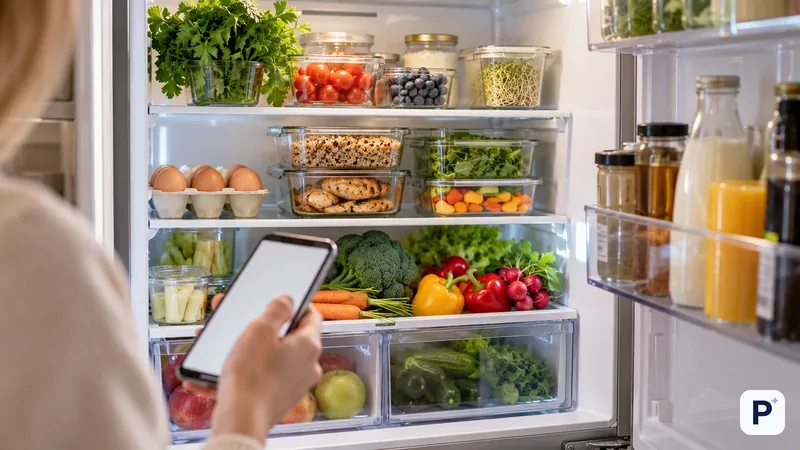
A fridge doesn't cool evenly everywhere, and that's the basis of all organisation. The top and middle shelves have the most stable temperature, so keep dairy, cold cuts and ready-made leftovers there. The bottom shelf is the coldest, which makes it the place for raw meat and fish, always in a sealed container so that juices don't drip onto the products below. The drawers at the bottom keep a higher humidity and are made for vegetables and fruit. The door is the warmest part of the fridge, so stable items belong there: sauces, mustard, drinks, jams. Guides to fridge zones, published among others by the sanitary inspectorate and government services, repeat the same pattern, because it simply works. The most important rule is this: one category, one place. When the dairy always sits in the same corner, you can see at once when it's running low. How long a given product will keep, you can check in our storage cheat-sheet, and herbs have their own separate needs, which we describe in our guide to storing fresh herbs. What exactly goes in the drawer, and what is better kept outside the fridge, we set out in our guide to storing fruit and vegetables.
Rotate Your Stock: Older to the Front
Even the best layout won't help if you always reach for whatever happens to be on top. That's why it's worth adopting a simple rule from shops, where they've always used it: older products go to the front and new ones to the back. When you come home from shopping, slide the fresh packaging behind what you already have, and move the older items to the front so you use them first. In English this is called FIFO, first in, first out, but it isn't about the name, it's about the habit. It applies equally to the fridge and the pantry, where it's easiest to end up with a forgotten jar or a packet of groats pushed deep into the shelf. When you put new things away, spend a second glancing at the date so you know what to set at the front. Thanks to that one second, pasta or a tin won't sit at the back of the cupboard until the moment they're only fit for the bin. In the pantry it also helps to set packaging with the label facing forward, so the name and date are visible without pulling out every packet one by one. Keep an eye on home-made preserves and jars in the same way, marking each jar with its preparation date; how to make them safely, we describe in our guide to how to preserve food in jars step by step.
Create a Use-First Zone
If you remember only one thing from this article, let it be this. Set aside one specific place in the fridge, ideally at eye level and at the front of the shelf, for products approaching their date. It could be a small basket or simply a designated corner, as long as it's always the same one. Whenever something is approaching the end of its shelf life, or is left over from dinner, it goes there. It's the simplest single anti-waste habit we know, because it turns the whole logic of the problem on its head. Instead of counting on remembering a product hidden at the back, you make what needs to be eaten today or tomorrow catch your eye every time you open the fridge. You look in for something to eat and you see this zone first. We write more about how much we really lose to unnoticed dates in our article on how much food we waste.
Containers and Labels: A Helpful Extra
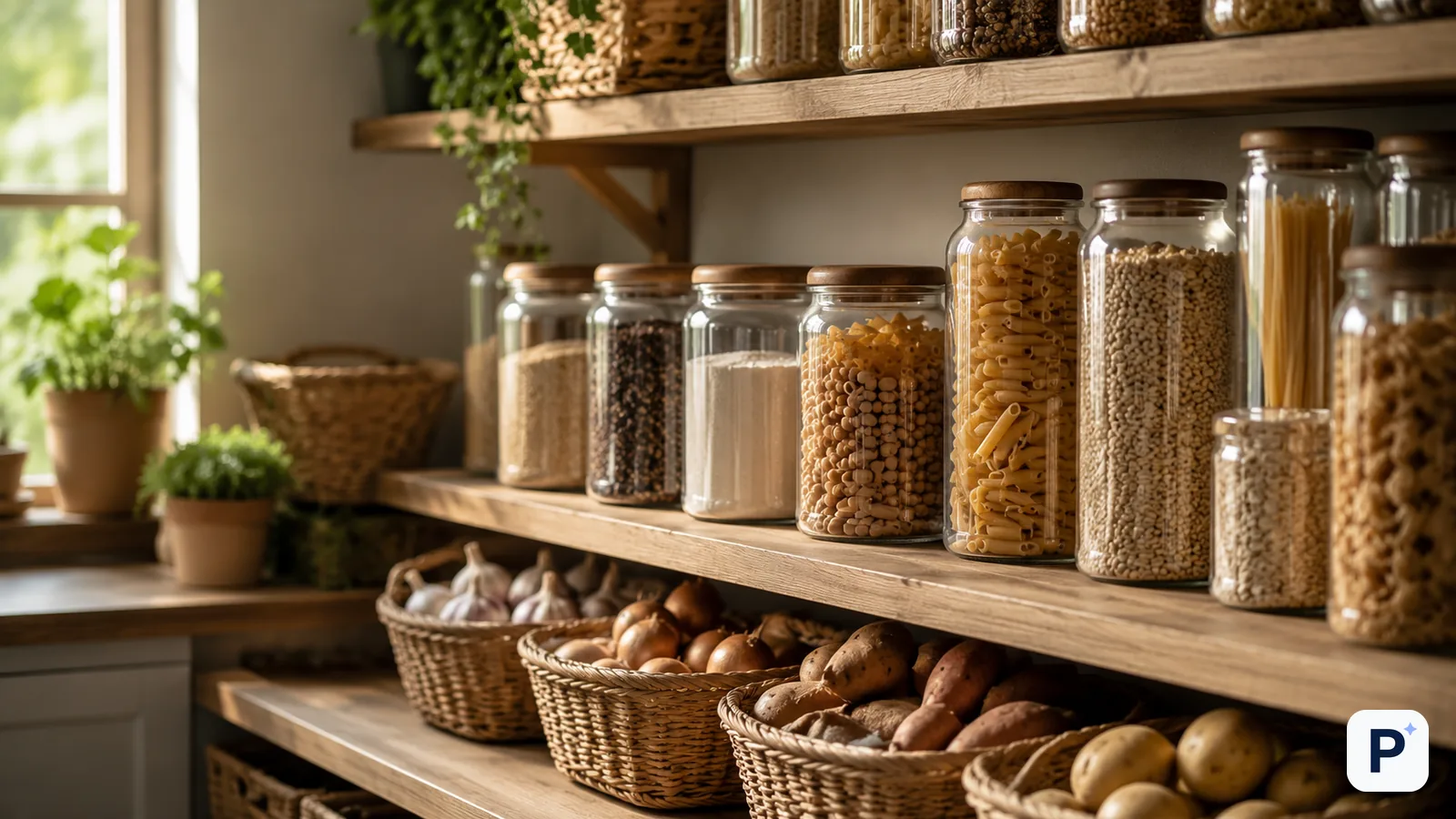
Only now, when you have a layout and zones, do containers really help. Transparent boxes are better than opaque ones, because you can see the contents without opening them and nothing gets lost in sealed darkness. It's worth labelling things with a date, especially items for the freezer and dry goods decanted into jars, because once frozen or decanted it's very easy to lose track of what something is and since when. How to do this well with dry goods, we describe in our guide to how to store flour, rice, groats and other dry goods. A separate, simple rule of hygiene: keep cleaning products and chemicals away from food, ideally on a different shelf or in a different cupboard. Remember, though, that containers and labels are a convenience, not a foundation. The foundation of order is the three things from the earlier paragraphs: the review, the zones and the rotation. Nice baskets put over mess with no system just make it a prettier mess. So buy containers only once you know what should stand where in them, and not the other way round. In practice, three or four transparent boxes for the most common categories, for example cold cuts, cheese and leftovers, are usually enough to make the fridge instantly easier to read.
Don't Overfill, and Do a Weekly Review
Two things keep the whole system alive. The first is not packing the fridge to the brim. Cold air has to circulate freely around the products, and in a crammed fridge it cools worse and unevenly, which speeds up spoilage. The same goes for the pantry, where an excess means you don't reach deep inside anyway and forget about half of your stock. The second thing is a short, weekly review. Once a week, spend five minutes, ideally just before shopping, to see what you have, what needs using up quickly and what's missing. This review isn't extra work, but a saving of time and money, because it feeds directly into your shopping list and meal plan. You see the dairy is running low, so it goes on the list, and what's waiting in the use-first zone decides dinner for the next few days. We set out this whole weekly review step by step in our guide to the weekly kitchen reset. How to turn this habit into lower bills, we describe in our guide to saving money on your shopping.
Match Your Stock to Your Own Rhythm
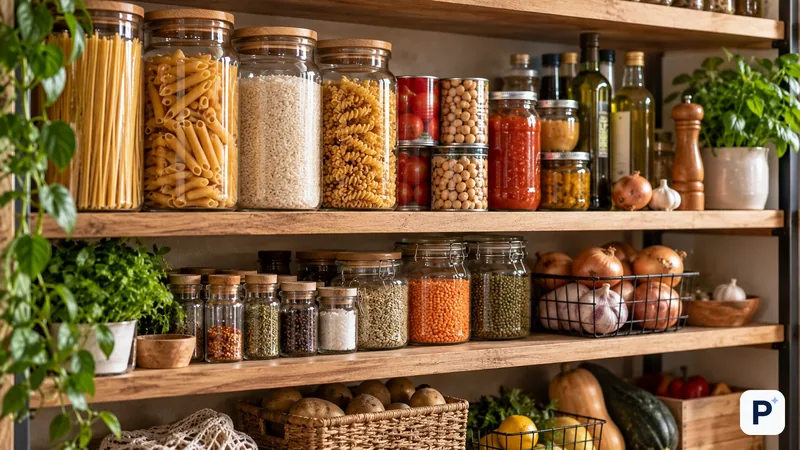
Finally, something that's easy to forget in the age of videos about perfect pantries. Your stock should match the way you really cook, not what looks good in a photo. Ten packs of pasta make sense only if you actually eat pasta every week. If not, those packs aren't stock, they just take up space and create the illusion of a full pantry in which there's still no idea for dinner. So buy to suit your own rhythm, not someone else's. The same applies to special offers. A big discount is tempting, but an offer stops being a saving the moment the product gets wasted. It's better to buy less and use everything than to fill the shelves and throw half of it away. A good test is to ask whether you remember the last time you reached for a given product. If you can't recall it, that's usually a sign you're buying it out of momentum rather than need. A well-organised kitchen isn't one that's full, but one in which you can see everything and everything has a chance of being eaten. What exactly is worth keeping so you can always put a dinner together, we set out in our guide to what's worth keeping in the pantry. You'll find more about shopping wisely in our article on saving money on your shopping.