Polish Tomato Soup
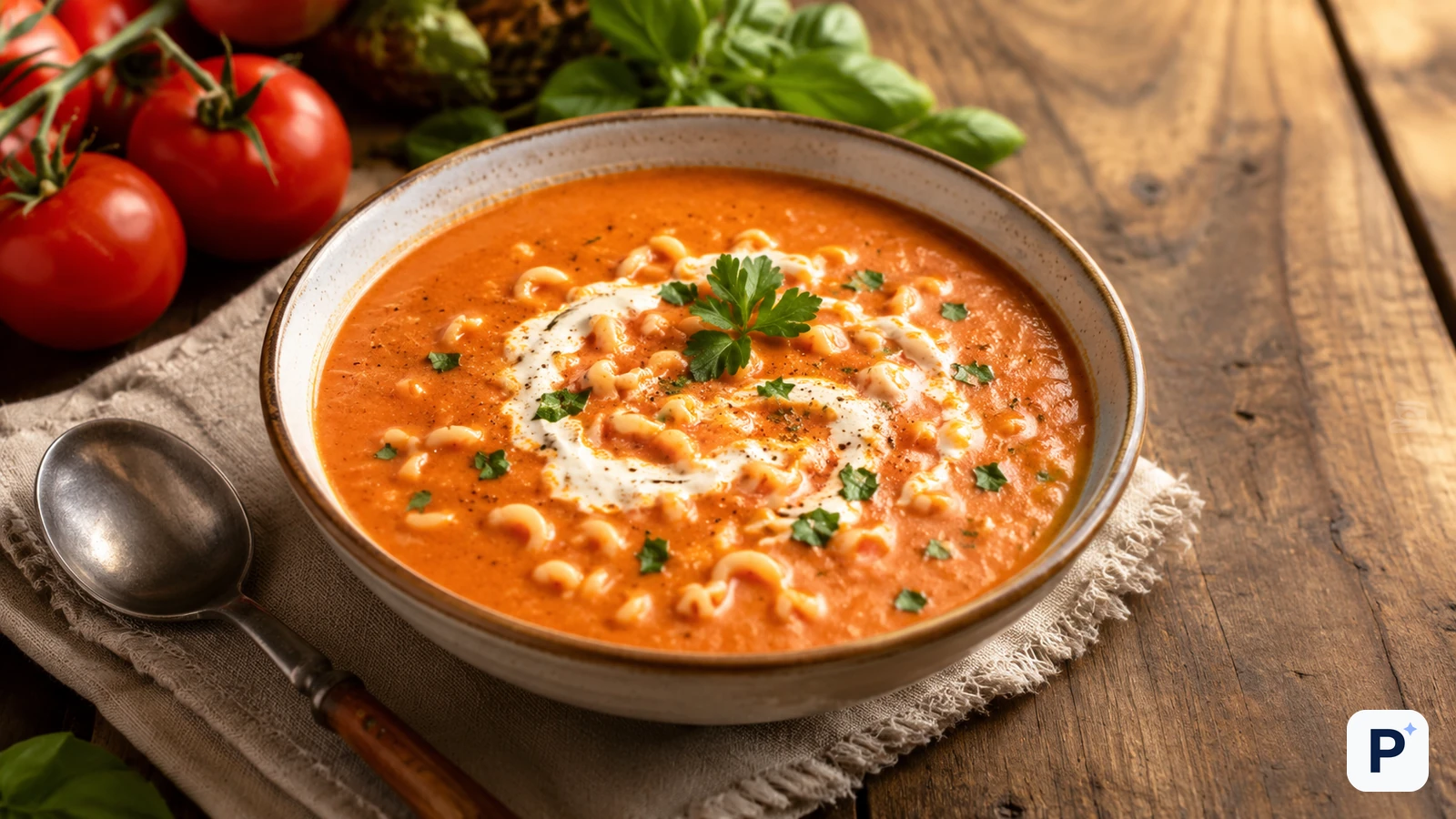
One of the most frequently cooked soups in Polish homes. You can make it from chicken broth left over from the day before, or from scratch with stock and passata. Creamy, distinctly tomatoey and ready in about half an hour.
Ingredients
- 1.5 litres of vegetable stock, chicken stock or leftover chicken broth from the day before
- 500 ml tomato passata
- 1–2 tablespoons tomato purée
- 1 onion
- 2 garlic cloves
- 1 carrot, optional
- 200 ml single or double cream (18% or 30%)
- 1 tablespoon butter or oil
- small pinch of sugar, optional
- salt
- freshly ground black pepper
To serve: pasta or rice cooked separately, flat-leaf parsley.
You can also add basil, oregano, a little sweet paprika or a pinch of chilli.
Instructions
- Peel the onion and cut it into a fine dice. Chop the garlic or press it through a garlic press. If you are using carrot, peel it and grate it on the coarse side of a grater.
- Heat the butter or oil in a large pot. Add the onion and fry over medium heat for about 3–4 minutes, until softened and translucent. Add the carrot and fry for a further 2 minutes or so.
- Add the garlic and fry for only about 30 seconds, until fragrant. Do not fry it for too long, as burnt garlic can give the soup a bitter taste.
- Add the tomato purée. Fry for about a minute, stirring constantly. Briefly frying the purée deepens its flavour and softens its raw acidity.
- Pour in the passata and stock. Stir thoroughly, bring to the boil, then reduce the heat.
- Cover the pot and simmer the soup over low heat for about 15–20 minutes. If you are using grated carrot, it should be tender by this point.
- Taste the soup. Season with pepper and, if needed, salt. If the tomatoes are very sharp, add a small pinch of sugar, stir and taste again.
- Reduce the heat to the lowest setting or take the pot off the hob. Pour the cream into a separate bowl and add a few spoonfuls of the hot soup to it, one spoonful at a time, stirring each time.
- Slowly pour the tempered cream into the pot, stirring constantly. Once the cream has been added, do not bring the soup back to a vigorous boil.
- Serve with pasta or rice cooked separately. On the plate you can add chopped flat-leaf parsley, basil or a little freshly ground black pepper.
Why does cream curdle in soup?
Most often it is because cold cream goes straight into very hot soup. The large difference in temperature causes the proteins to set suddenly, and instead of a smooth, creamy liquid you get small lumps.
The simplest solution is to temper the cream. Pour it into a bowl, add a few spoonfuls of the hot soup and mix thoroughly. Then add a little more soup so that the temperature of the cream rises gradually. Only cream prepared this way should be poured into the pot.
Once the cream has been stirred in, do not boil the soup vigorously. Gently warming it through is enough. Double cream (30%) is more resistant to curdling than the more acidic single cream (18%), but tempering is a good habit with either option.
What to do if the cream has already curdled?
If only small specks have appeared, the soup is still perfectly fine to eat. The problem is mainly one of appearance and texture.
You can try mixing the soup thoroughly with a whisk. If you want a completely smooth texture, use a hand blender. Next time, temper the cream and add it only after lowering the temperature of the soup.
How to balance a sharp tomato soup
Not every passata and not every tomato tastes the same. Some are naturally sweeter, others very sharp. That is why sugar should not be added automatically in a fixed amount.
First taste the soup after a dozen or so minutes of cooking. If it is still noticeably sharp, you have a few options:
- Add a small pinch of sugar. The point is not to make the soup sweet, but to balance the acidity.
- Fry the tomato purée before adding the liquid. Its flavour becomes deeper and less raw.
- Add carrot. Its natural sweetness gently balances the tomatoes.
- Add cream. The fat softens the sharpness and acidity of the flavour.
Do not try to fix a sharp soup all at once with a large amount of sugar. Add it literally a pinch at a time and taste after each addition.
Tomato soup made from chicken broth
This is one of the most classic ways to use up leftover chicken broth from the day before. Instead of cooking another soup from scratch, you use a ready-made base that already has the flavour of vegetables, meat and seasoning. In practice you simply add passata and tomato purée, season the whole thing and finish with cream at the end.
If the broth was heavily seasoned, do not add salt at the beginning. The passata, tomato purée and the later reduction can strengthen the flavour further, so it is best to season the soup only towards the end.
If there are vegetables left in the broth, you can use those too. You can slice the carrot and leave it in the soup, or blend it together with part of the tomato base. This is a good example of cooking "one base, two dinners": chicken broth on the first day, tomato soup on the second.
Passata, tinned tomatoes or fresh tomatoes?
Each of these options works, but each gives a slightly different result.
Passata. The simplest and most predictable option. It is already smooth, so it does not need blending. It works well all year round and lets you make the soup very quickly.
Tinned tomatoes. These give a more rustic texture. You can leave small pieces of tomato, or blend the soup until smooth after cooking. One tin, about 400 g, can be treated as a replacement for part of the passata.
Fresh tomatoes. These work best in summer, when they are really ripe and aromatic. Chop them, fry them together with the onion or add them to the stock and cook until soft. With fresh tomatoes the soup usually needs a little more time and may need blending, and the flavour depends far more on the season. If you want to make a quick tomato soup in November, a good passata will usually be a safer choice than pale fresh tomatoes.
With pasta or with rice?
There is no single right answer here. In many Polish homes it is almost a family matter. Tomato soup goes well with small pasta, vermicelli, fusilli, bow-tie pasta or rice. You can also serve it without any addition, especially if it is more creamy and filling.
It is worth cooking the pasta and rice separately, though, especially if the soup is also meant to last until the next day. Pasta left in the pot for several hours starts to absorb the liquid. The next day it may be very soft and the soup much thicker than before. Rice behaves in a similar way.
So cook the addition separately, put the right portion straight into the bowl and only then pour the hot soup over it. This also makes it easier to store the remaining tomato soup or freeze it.
How to make a lighter tomato soup
The simplest way is to reduce the amount of cream or leave it out altogether. You can use 100 ml of cream instead of 200 ml, or add a small amount of milk. With milk it is especially important not to boil the soup over very high heat afterwards.
Another option is to leave the tomato soup without any cream at all. Passata, stock, vegetables and well-chosen seasoning are enough to give a full flavour. If you want to keep it creamy without a lot of cream, you can blend the carrot and onion together with a small portion of the soup.
Vegan tomato soup
Use vegetable stock and oil instead of butter. You can replace the cream with a plant-based cooking cream or a small amount of coconut milk.
Coconut milk clearly changes the flavour and takes the soup away from the classic Polish tomato soup, but it combines very well with tomatoes. If you choose this option, you can add chilli, ginger or a little curry and turn the same base into a completely different dish.
If you want a flavour as close as possible to the classic tomato soup, choose a neutral plant-based oat or soya cooking cream.
Substitutes
No passata? Use tinned tomatoes and blend the soup after cooking.
No tomato purée? You can leave it out. The tomato flavour will be a little milder.
No cream? Leave the soup without it, or use a plant-based alternative.
No fresh onion? In an emergency version you can make the soup without it and season the stock more strongly.
No carrot? Leave it out. It is an addition, not an essential part of the recipe.
No pasta? Serve the tomato soup with rice, croutons, bread or on its own.
Do you have some cooked rice or pasta left? If it was stored properly, you can use it as an addition instead of cooking a new batch.
What can you add to tomato soup?
The basic recipe can easily be changed without preparing a completely new soup. If you have the following to use up:
- half a red pepper, fry it together with the onion,
- a few tomatoes, add them to the passata,
- a piece of celeriac or parsley root, cook it in the stock,
- some leftover fresh basil, add it before serving,
- an opened carton of cream, use it instead of buying a separate pack of cream,
- slices of stale bread, turn them into croutons.
Soup is a very forgiving way to use up small amounts of products that would be hard to turn into a full dish on their own.
How to store tomato soup
After cooking, do not leave a large pot on the kitchen worktop for many hours. Cool any soup you are not going to eat and move it to the fridge. In an airtight container you can keep it for roughly 2–3 days.
It is most convenient to keep the soup separately from the pasta or rice. That way the additions do not go soft and absorb most of the liquid. Reheat only the portion you intend to eat, instead of repeatedly warming up the whole pot.
If you are not sure how long to keep soup and other ready meals, see our guide on how long to store cooked food, with approximate storage times.
Can you freeze tomato soup?
Yes. Tomato soup is very well suited to portioning and freezing, especially if you make a larger pot.
It is best to freeze it before adding the cream. Dairy can separate after thawing and change the texture. This does not automatically mean the soup will be inedible, but it may look and taste worse.
If you plan to freeze part of the soup, do this:
- After cooking the base, set aside the portions meant for freezing.
- Add cream to the rest and serve it straight away.
- Cool the portions for freezing quickly and transfer them into suitable containers.
- Leave a little free space, as liquid expands during freezing.
- After thawing, heat the soup and only then add fresh cream.
Pasta and rice are also best stored or frozen separately.
What to do with leftover chicken broth?
Tomato soup is probably the most obvious idea, but chicken broth can be the base for far more meals. You can cook a larger batch of stock and use it over the following days for:
- tomato soup,
- a cream soup,
- a sauce,
- risotto,
- a barley risotto (kaszotto),
- braised vegetables,
- cooking groats or rice.
So instead of thinking of chicken broth only as a single Sunday dinner, treat it as a ready-made culinary base. It is exactly the same system that works well for meal planning: you prepare one base and then use it in several different dishes.
If you are interested in this kind of batch cooking, see also the guide How to Plan Meals for the Week. You will find more examples there of preparing bases instead of seven identical ready meals.
Tomato soup as a way to get a second dinner from the same products
Cooking for two days does not have to mean eating exactly the same thing. If you cook chicken broth one day, the next day you can turn it into tomato soup. If a small portion of soup is still left, you can blend it, reduce it further and use it as the base for a simple tomato sauce.
This way of thinking lets you use products up fully without feeling that you are eating the same dinner for three days. Instead of planning each dish as a separate set of ingredients, you start to connect them in a sequence: chicken broth, tomato soup, another meal using whatever is left.