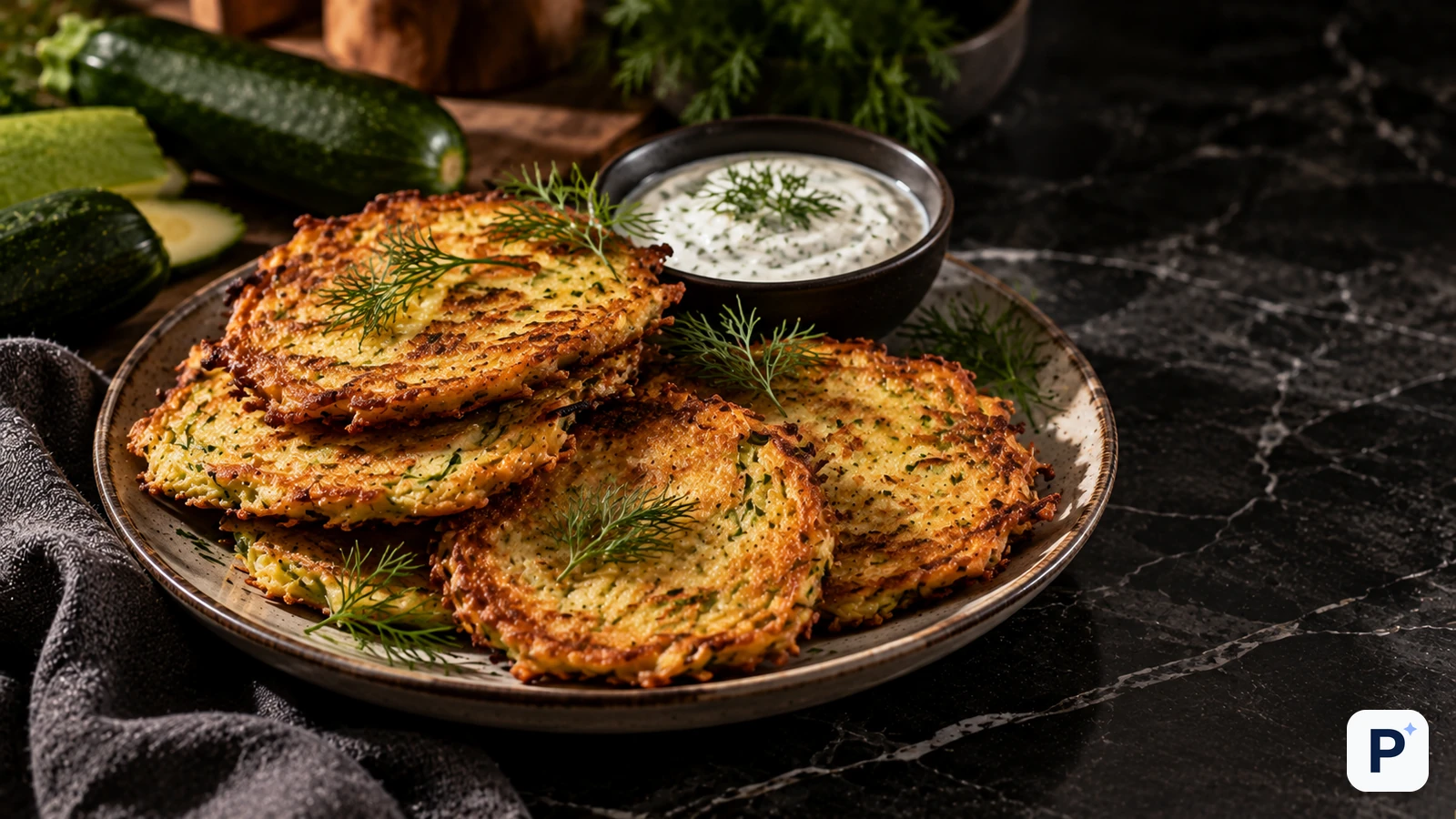
Courgette Fritters (Placki z Cukinii)
Light, crispy at the edges, soft in the middle and much quicker than potato pancakes, because young courgette does not need to be peeled. The whole secret to successful courgette fritters comes down to one important stage: squeezing out the water thoroughly. Courgette contains a great deal of it, and the excess makes the batter runny, so the fritters fall apart while frying and, instead of browning, start to steam. This portion makes dinner or a light supper for 2-3 people.
Ingredients
- 2 medium courgettes, about 500 g
- 2 eggs
- 4–6 tablespoons plain flour
- 1 small onion, optional
- 1–2 garlic cloves
- about ½ teaspoon salt for salting the courgette
- extra salt to taste
- pepper
- dill or parsley, optional
- oil for frying
Optionally, you can also add a small amount of cheese, feta or other herbs.
How to make courgette fritters
- Grate the courgette. Wash the courgette thoroughly. If it is young, you do not need to peel it. Grate it on the coarse side of a grater. If the courgette has very large seeds and is heavily overgrown, you can cut it lengthways and remove the soft centre before grating.
- Salt it and set it aside. Transfer the grated courgette to a large bowl and add about ½ teaspoon of salt. Set aside for 10–15 minutes. Salt helps draw the water out of the vegetable. After this time you will see a fair amount of liquid gather at the bottom of the bowl. Do not skip this stage. The amount of flour alone will not solve the problem of very watery courgette.
- Squeeze the courgette very thoroughly. This is the most important step of the whole recipe. Transfer the courgette to a clean kitchen towel, muslin cloth or a sturdy sieve and firmly squeeze out the excess water. If you use a towel, gather it in your hands and squeeze until no more large amount of liquid runs out. You can also squeeze the courgette in batches in a sieve, pressing it firmly with your hand or a spoon. From about 500 g of grated courgette you may be left with roughly 300–400 g of squeezed pulp, but the exact amount depends on the variety and how juicy the courgette is. The better you squeeze the vegetable, the easier it will be to get firm and crispy fritters.
- Prepare the batter. Transfer the squeezed courgette to a bowl. Add the eggs, 4 tablespoons of flour, garlic pressed through a crusher, finely chopped onion, pepper and chopped dill or parsley. Mix. Taste the batter and add a little salt if needed. Remember that the courgette has already been salted, so do not automatically add a large amount.
- Check the consistency. The batter should be moist and soft, but not watery. When scooped up with a spoon it should hold its shape for a moment, rather than immediately spreading across the bowl. If the batter is too runny, add flour one tablespoon at a time. Do not add 6 or 8 tablespoons at once. Courgette can have a different water content after squeezing, which is why the amount of flour must be adjusted to the particular batter. Too much flour will make the fritters heavy and rubbery.
- Heat the pan. Heat a thin layer of oil in a frying pan. The fat should be well heated, but it should not smoke. If the batter hits a cold pan, it will start to absorb the fat and may spread. Too high a temperature, on the other hand, will quickly burn the outer layer before the centre has had time to cook.
- Fry the fritters. Spoon the batter onto the pan and gently flatten it. Do not make very thick fritters. Thinner ones fry more easily and their edges will be crispier. Leave a little space between them. If you put too much batter on the pan at once, the temperature will drop and the fritters will start to steam instead of fry. Fry over medium heat for about 3–4 minutes on one side. When the underside is golden and set, gently turn the fritters over. Fry the other side for another 2–4 minutes, until it also browns.
- Do not cover the pan. While frying, do not cover the fritters with a lid. Courgette contains a lot of water, and a closed lid traps the steam. Instead of drying out and turning crispy, the fritters start to go soggy. After frying you can set them on a paper towel to absorb excess fat. If crispiness matters most to you, a metal rack or grid is even better, as air can flow freely underneath as well. Serve immediately.
Why do you need to squeeze the courgette?
Courgette contains a great deal of water. After grating, some of this water is released, and during frying even more appears.
If you add courgette that is too wet to the batter, the fritters may:
- fall apart when turned,
- take a long time to fry,
- absorb more fat,
- not brown properly,
- turn out soft instead of crispy.
That is why it is better to spend a few minutes squeezing the courgette thoroughly than to try to rescue a runny batter later with a large amount of flour.
What is the best way to squeeze the courgette?
The most effective option is a clean kitchen towel or muslin cloth.
Grate the courgette, salt it, wait a dozen or so minutes, then transfer it to the centre of the fabric. Wrap it up and squeeze firmly.
If you do not have a towel, you can use a large sieve. Transfer the courgette into it and press very firmly with your hand or a spoon. With a larger amount it is worth doing this in batches.
Simply leaving the courgette in the sieve is not enough. Water will run out of it, but a fair amount will still remain in the vegetable.
How much flour to add to courgette fritters?
Start with 4 tablespoons of flour. If the batter is still very loose after mixing, add further portions one tablespoon at a time.
There is no single ideal amount of flour, because courgettes differ in size and water content. Getting the right consistency is far more important.
Too little flour: the batter may fall apart and it will be difficult to turn the fritters.
Too much flour: the fritters become heavy, dense and rubbery.
If the courgette has been squeezed very well, you probably will not need the maximum amount of flour.
Why do courgette fritters fall apart?
The most common cause is too much water in the courgette. If the batter is very wet, it is hard to achieve a stable structure during frying.
A second cause can be too few binding ingredients, that is, eggs and flour.
The way you fry them also matters. If you try to turn the fritters too early, before the underside has set properly, they may fall apart in the pan.
That is why you should not move them unnecessarily. Wait until the underside is clearly golden and stable, and only then gently lift the fritter with a spatula.
Why are courgette fritters rubbery?
Usually two things are to blame: too much flour or too much moisture.
If the courgette has been poorly squeezed, you may try to thicken the batter with a larger amount of flour. The problem is that after frying you will get heavy, rubbery fritters.
That is why it is better to squeeze the courgette thoroughly at the start and use a smaller amount of flour.
Rubberiness can also come from fritters that are too thick. Thinner ones fry faster and have a better ratio of crispy surface to soft centre.
Why not cover the fritters while frying?
A lid traps the steam.
In the case of courgette fritters this matters especially, because the vegetable itself contains a lot of water. The steam that stays under the lid makes the surface of the fritters go soft.
If you want golden, crispy edges, fry them without a cover.
If the centre is still raw, do not cover the pan. Instead, lower the heat and fry the fritters a little longer.
Do you need to peel the courgette?
Young courgette does not need to be peeled. The skin is delicate, softens quickly during frying and also gives the fritters a little colour.
Peeling makes sense mainly for very large, mature courgette with a thick, hard skin.
If the vegetable has large seeds and a very soft, watery centre, it is also worth removing the centre before grating.
What can you add to courgette fritters?
The basic recipe can easily be varied depending on what you have in the fridge.
Hard cheese: adds a more intense flavour and helps achieve a more golden surface.
Feta: gives a salty, pronounced flavour. In that case, add salt carefully.
Carrot: you can grate a small amount together with the courgette. Remember, though, that extra vegetables also change the moisture of the batter.
Herbs: dill, parsley, chives, basil or oregano go well with courgette.
Garlic: fresh garlic works well in the savoury version, especially if you serve the fritters with a yoghurt sauce.
What to serve with courgette fritters?
The simplest option is to serve them with plain yoghurt, soured cream or garlic sauce.
They also go well with:
- a yoghurt and herb sauce,
- tzatziki,
- garlic sauce,
- tomato sauce,
- feta,
- fresh tomatoes,
- a fried egg,
- a fresh vegetable salad.
You can also prepare them in a more classic way and serve them with soured cream.
If you like sweet and savoury combinations, courgette fritters can also be served with a little sugar or sweet. In that case, skip the garlic, pepper and strong herbs.
Courgette fritters or potato pancakes?
Both dishes are prepared in a similar way, but courgette fritters have a few practical advantages.
Young courgette does not need to be peeled, preparing the vegetable is quick, and the frying itself does not require any earlier preparation of potatoes.
Courgette fritters can also be lighter, depending on the proportions of the ingredients and the amount of fat used for frying.
If you have potatoes and want to make the classic version, see also the recipe for potato pancakes.
How to store courgette fritters?
They taste best right after frying, but you can keep any leftover fritters in the fridge.
Once they have cooled, transfer them to a sealed container and put them in the fridge. It is best to use them within a few days.
Do not stack very hot fritters on top of one another in a sealed container. The steam can make them lose their crispiness.
How to reheat courgette fritters?
The best way is a frying pan. Heat it without a large amount of fat and warm the fritters over medium heat on both sides. This way their surface browns again and regains some of its crispiness.
A microwave is faster, but the fritters will turn soft in it, because they heat up in the presence of steam.
If you are preparing a larger portion with the next day in mind, reheating in a pan definitely gives a better result.
Can you freeze courgette fritters?
You can, although after thawing their structure will be slightly less crispy than fresh off the pan.
It is best to cool the fried fritters, separate them with baking paper and freeze them in a sealed container or bag.
After thawing, warm them in a dry or lightly oiled pan. Do not thaw them for a long time at room temperature.
Ingredient substitutions
Plain flour: you can use rice flour, cornflour or chickpea flour. Each of them has slightly different properties, so add it gradually and watch the consistency.
Eggs: they are the basic binding ingredient. For an egg-free version you need to use an additional binder, for example a small amount of starch or a suitably chosen flour.
Onion: you can leave it out entirely or replace it with chives.
Garlic: it is not essential. If the fritters are to be served sweet, it is best to leave it out.
Dill and parsley: choose one of them or use other fresh herbs you have to hand.
The most important rules for crispy courgette fritters
If you want to avoid fritters that fall apart or turn rubbery, remember a few things:
- Young courgette does not need to be peeled.
- After grating, salt it and wait 10–15 minutes.
- Squeeze out the excess water very thoroughly.
- Start with 4 tablespoons of flour and add more only when the batter is too runny.
- Do not make very thick fritters.
- Wait to turn them until the underside is well browned and set.
- Fry over medium heat, in well-heated fat.
- Do not overcrowd the pan.
- Do not cover the pan while frying.
- Serve immediately, or reheat in a pan if you want to keep the crispiness.