What to Do with Courgettes: Dinner Ideas and More
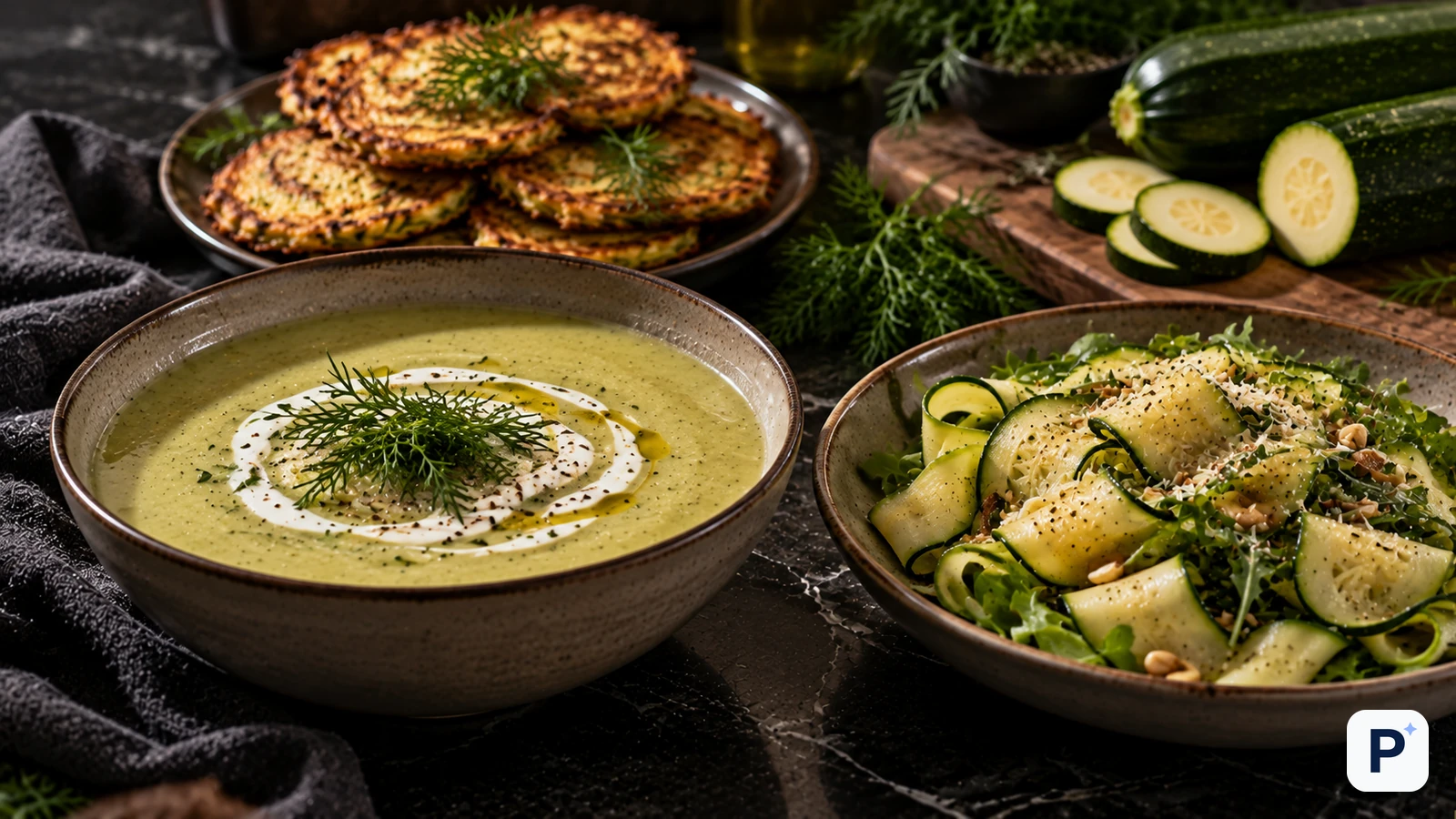
The courgette is one of the most versatile vegetables there is. From a single one you can make fritters, a creamy soup, leczo (a Central European vegetable stew), pasta, a bake, stuffed courgette and even a cake.
The problem usually appears when you have too many courgettes. In summer, a single plant can produce them faster than you are able to eat them. But even one courgette bought at the shop can end up waiting in the fridge a few days later for an idea.
That is why, instead of wondering what to do with your courgettes, you should start with how many you have and what condition they are in.
A small, firm courgette is perfect for quick frying or griddling. A few of them can be turned into a soup or leczo. A large, overgrown courgette is best used in dishes where its texture matters less.
If you have a glut of courgettes, you can also freeze some of them.
Courgette Fritters: The Simplest Idea
Courgette fritters are one of the easiest ways to use up this vegetable.
Grate the courgette, sprinkle it with a little salt and set it aside for a few minutes. Then squeeze out the excess water very thoroughly. It is this step that most often decides whether the fritters will hold together or start to fall apart in the pan.
Add an egg, flour and seasoning to the squeezed-out courgette. You can also throw in garlic, dill, chives, parsley or grated cheese.
You do not need to peel a young courgette.
You can serve the fritters with natural yoghurt, a garlic sauce, feta, smoked salmon or simply with a salad.
This works well for both a single courgette and a larger amount. For a bigger batch, simply prepare the mixture in stages so that it does not sit for too long and release more water.
See our recipe for courgette fritters.
Creamy Courgette Soup
If you have several courgettes at once, a creamy soup lets you use up a great many of them.
Chop the courgettes and sweat them with onion and garlic. Add a potato if you want a creamier, thicker texture, pour in stock and cook until soft. Then blend the lot.
The courgette has a mild flavour, so it is easy to change the character of the soup with extra ingredients.
You can add:
- single cream,
- cream cheese,
- Parmesan,
- dill,
- basil,
- parsley,
- pumpkin seeds,
- croutons,
- olive oil.
A creamy soup is also a good solution for a larger or slightly overgrown courgette. Once it has been cooked and blended, its less-than-perfect texture no longer matters much.
If you make a large pot, you can set some aside for the next day and freeze the rest in portions, once it has been properly prepared and cooled.
Leczo with Courgette
The courgette works very well in one-pot dishes.
You can make a classic leczo with courgette, peppers, onion and tomatoes. You can also add sausage or chicken, or make a completely vegetable version.
This is a particularly good way to deal with a glut of courgettes, because you do not have to use them in one specific proportion. If you have more of the vegetable, simply increase its share in the dish.
You can serve leczo on its own, with bread, rice or groats.
Another big advantage is that it lends itself well to making a larger batch. You can eat some straight away and keep the rest for another dinner or freeze it.
See our recipe for leczo.
Pasta with Courgette
Courgette and pasta are a combination you can use in several ways.
The simplest is to cut the courgette into half-moons or dice and fry it with garlic. Then all you have to do is add cooked pasta and a sauce.
Good options include:
- a cream sauce,
- pesto,
- a tomato sauce,
- a cheese sauce,
- olive oil with garlic and herbs.
You can also add chicken, feta, sun-dried tomatoes, spinach or mushrooms.
If you already have cooked pasta, a dish like this can come together in a dozen or so minutes.
See our recipe for creamy pasta with chicken and courgette.
What About Courgette as the Pasta Itself?
You can cut the courgette into thin strips with a spiraliser or a peeler and use it as a vegetable base for a sauce.
It does not behave in exactly the same way as ordinary pasta, though. The courgette contains a lot of water, so it softens quickly once heated.
It is best to fry or warm it briefly and combine it with the finished sauce just before serving.
Stuffed Courgette
If you have a larger courgette, you can use it as a natural 'vessel' for a filling.
Cut it in half lengthways and scoop out some of the flesh. With very large, overgrown courgettes it is worth removing the hard or very soft seed core as well, and keeping mainly the firm part of the flesh.
You can fill them with:
- minced meat,
- rice,
- groats,
- lentils,
- vegetables,
- mushrooms,
- cheese,
- a mixture of several ingredients.
Mozzarella, feta, Cheddar or Parmesan all work well on top.
Then you bake the courgette until soft.
This is a good way to use a large one that you could not face grating for fritters.
Roasted Courgette
You do not always have to make a complicated dish out of courgettes.
Cut it into slices, half-moons or batons, toss it with a little olive oil and seasoning, and then roast it.
You can use:
- garlic,
- oregano,
- thyme,
- paprika,
- chilli,
- Parmesan,
- herbes de Provence.
The courgette works well as a side for meat, fish, groats or rice.
Courgette Chips
You can also cut the courgette into batons and cook it in the oven.
If you want a crispier surface, you can use a coating, breadcrumbs or a mixture of breadcrumbs and Parmesan.
Bear in mind, though, that the courgette contains a lot of water, so these chips will not behave exactly like potato chips. They are best served as soon as they are made.
Griddled Courgette
The courgette is also superb on the griddle.
Cut it lengthways into long slices or into thicker rounds, brush it with a little olive oil and season it.
On the griddle it needs just a few minutes on each side, depending on the thickness.
You can serve it as a side for meat or fish, or use it later in a salad, sandwich or wrap.
This is a particularly good way to use a young, firm courgette.
Courgette Bake
The courgette can also be the base for a simple bake.
Combine it with eggs, cheese and other vegetables, then bake it. You can also add potatoes, pasta, rice, minced meat or chicken.
If the courgette is very watery, it is worth frying or squeezing it a little beforehand, because it will release water during baking too.
This way the bake will hold together better.
Sweet Courgette: Cakes and Muffins
The courgette does not have to stop at dinner.
Grated courgette can be an ingredient in a cake, because it adds moisture to baking. Its flavour is relatively mild, so it goes especially well with chocolate and spiced bakes.
You can make:
- a chocolate courgette cake,
- muffins,
- a bundt cake,
- a moist spiced cake,
- courgette bread.
With a very watery courgette it is worth pouring off or gently squeezing out the excess liquid, especially if the recipe does not allow for a large amount of water.
This is also a good way to use up a large courgette that you no longer want to put in a salad or on the griddle.
Too Many Courgettes? Split Them Across Several Dishes
If you have several kilograms of courgettes, do not try to use everything up in the same way over a single weekend.
The easiest approach is to split the glut into three groups.
For now: use young, firm courgettes for fritters, griddling, frying or pasta.
For a bigger dinner: use a few of them for leczo, a creamy soup, a bake or stuffed courgette.
For later: prepare the surplus for freezing.
For example, from a few kilograms you can make a large pot of leczo, a batch of creamy soup, a few dinners with roasted or griddled courgette, and freeze the rest.
That way you are not eating the same dish for a week, and at the same time you are not letting the whole vegetable go to waste.
How to Store Courgettes
The courgette is not a vegetable that should sit in the pantry for months.
It is best kept in the fridge, in the vegetable drawer, and used within a few days or roughly a week, depending on how fresh it was when you bought it.
You do not need to wash it before putting it away. If it is damp, it is worth drying it off.
Do not seal it tightly in damp cling film, because trapped moisture can encourage rotting. It is better to give it a little ventilation or use packaging designed for storing vegetables.
Before using it, check its surface.
A courgette that is only slightly soft or wrinkled may still be fine for cooking. You can use it in a soup, leczo, a sauce or a bake, where perfect firmness is not the most important thing.
If there is mould, a slimy surface, a clearly unpleasant smell or signs of rot, do not try to save it by cutting off a small piece.
How to Freeze Courgettes
If you have a large glut of courgettes, freezing is a good way to keep them for later.
There is one thing to bear in mind, though: once thawed, the courgette will be much softer and more watery than fresh.
That is why it is best to freeze it with a specific use in mind.
It will work well later in:
- a soup,
- leczo,
- a sauce,
- a bake,
- fritters,
- one-pot dishes.
It will not, however, be a good substitute for fresh courgette in a salad or in a dish where you want some crunch.
How to Prepare Courgettes for Freezing
Wash it, dry it and cut it into pieces suited to how you will use it later.
Slices and pieces intended for cooking or frying can be briefly blanched first and then cooled quickly. This helps preserve better quality during freezing.
Grated courgette intended for fritters can be frozen without blanching first. After thawing, though, you need to squeeze out the water very thoroughly before preparing the mixture.
The most convenient way is to freeze the courgette in portions that match a single dish. Do not freeze the whole glut in one enormous bag.
Label the packaging with the date and contents. In the freezer it is easy to forget what is inside.
To keep it at good quality, it is best to use frozen courgette within a few months rather than treating it as something you can store indefinitely.
You will find more general rules in our guide to what you can and can't freeze.
What to Do with a Very Large, Overgrown Courgette
A courgette from your own garden can grow much larger than you planned.
That does not automatically mean you have to throw it away.
A large courgette may, however, have:
- a tougher skin,
- larger seeds,
- more watery or fibrous flesh.
In that case you can peel it, cut it in half lengthways and remove the soft or hard seed core. Use the remaining flesh mainly for cooked and baked dishes.
It will work well in:
- a creamy soup,
- leczo,
- a sauce,
- fritters,
- a bake,
- a cake,
- preserves.
If the courgette is already clearly spoiled, slimy, mouldy or has an unpleasant smell, its size is irrelevant. You should not try to save a vegetable in that state.
Not Every Courgette Has to Go into One Recipe
One of the courgette's greatest advantages is that you can adapt it to the situation.
Have one young courgette? Make fritters, pasta, griddled or roasted courgette.
Have two or three? Make a soup, a bake or a larger batch of leczo.
Have a large courgette? Hollow it out and stuff it, or use it for a soup, fritters or a cake.
Have a whole basket? Cook some, use some for everyday dinners, and prepare the rest for freezing.
This way you do not have to force yourself to find a single recipe that will use everything up.
First Check What You Have and What Needs Using Up
The courgette does not call for complicated planning. You simply need to notice it early enough.
If it is fresh and firm, you can cook it in the simplest way.
If it is starting to soften, choose a dish in which texture will not be the most important thing: a soup, leczo, a sauce or a bake.
If you have far too much of it, freeze some.
The worst thing to do is leave the courgette in the fridge drawer thinking that 'something will come to mind later'. After a few days it may be much harder to use.
This is exactly where PantryOS comes in. You can keep track in the app of the food you have at home and more easily spot what should be used first.
Because the best way to deal with a glut of courgettes does not start with another recipe. It starts with noticing early enough that you have too many.