What to Do with Leftover Egg Whites: Sweet and Savoury Ideas
Have you made mayonnaise, a custard, ice cream or a cake using only the yolks, and been left with a bowl of egg whites?
Don't pour them down the sink. Egg whites are a proper ingredient in their own right, and you can use them to make a dessert, a quick breakfast or an addition to dinner.
The best part is that you don't have to go straight out and look for a specific recipe. All you need to do is check how many egg whites you have left.
One or two can be used in everyday cooking. With three or four, you can make coconut macaroons or a small batch of meringue. A larger amount opens the door to a pavlova, macarons or a bigger bake.
And if you have no idea what to do with them today, you can safely keep egg whites in the fridge or freeze them for later.
First, Check How Many Egg Whites You Have
This is the simplest way to make a decision.
- 1–2 egg whites: an omelette, pancakes, a coating, or an addition to a mince mixture for cutlets or to a plain omelette.
- 3–4 egg whites: coconut macaroons, a small meringue, little meringues, or a small batch of biscuits.
- 5–6 egg whites: a pavlova, a larger meringue, an egg-white sponge, or an angel food cake.
- More than that: a larger pavlova, macarons, or a bake that uses a larger quantity of egg whites.
This is not a rigid rule, of course. Specific recipes use different proportions, so always check the recipe before you start cooking.
It's mainly about one simple principle: count the egg whites first, then choose the recipe.
That way, you won't end up with yet another dish that requires five additional purchases just to use up two tablespoons of an ingredient.
What to Do with 1–2 Egg Whites
With a small amount, there is no point preparing a large dessert. It's better to use the egg whites as part of a dish you are planning to make anyway.
Egg-white omelette. The simplest option is an omelette. You can whisk the egg whites or simply beat them together with a pinch of salt and pour them into the pan. Add vegetables, chives, herbs, cheese or leftover roast meat. If you have a single egg white left, you can also add it to an omelette made with whole eggs. You don't have to prepare a separate dish just to use it up.
Pancakes. An egg white can also go into the batter for pancakes. You can combine it with banana, oats, flour, farmer's cheese (Polish twaróg) or whatever other ingredients you use for your pancakes. This is a particularly good way to use one or two egg whites when you don't want to make a large bake.
Coating. An egg white also works well as a layer that helps breadcrumbs stick to food. You can dip meat, fish or vegetables into it and then coat them in breadcrumbs or another coating. If you have only one egg white left, it doesn't have to wait for a special recipe.
Cutlets, meatballs and fillings. An egg white can also be an ingredient in the mixture for cutlets, meatballs or some fillings. If you happen to be making a dish like this, check the recipe and the proportions. Sometimes an extra egg white can help bind the mixture, but it isn't always necessary. This is a good example of using up a leftover without creating another dish.
What to Do with 3–4 Egg Whites
This is where you start to find desserts that really are designed with a larger quantity of egg whites in mind.
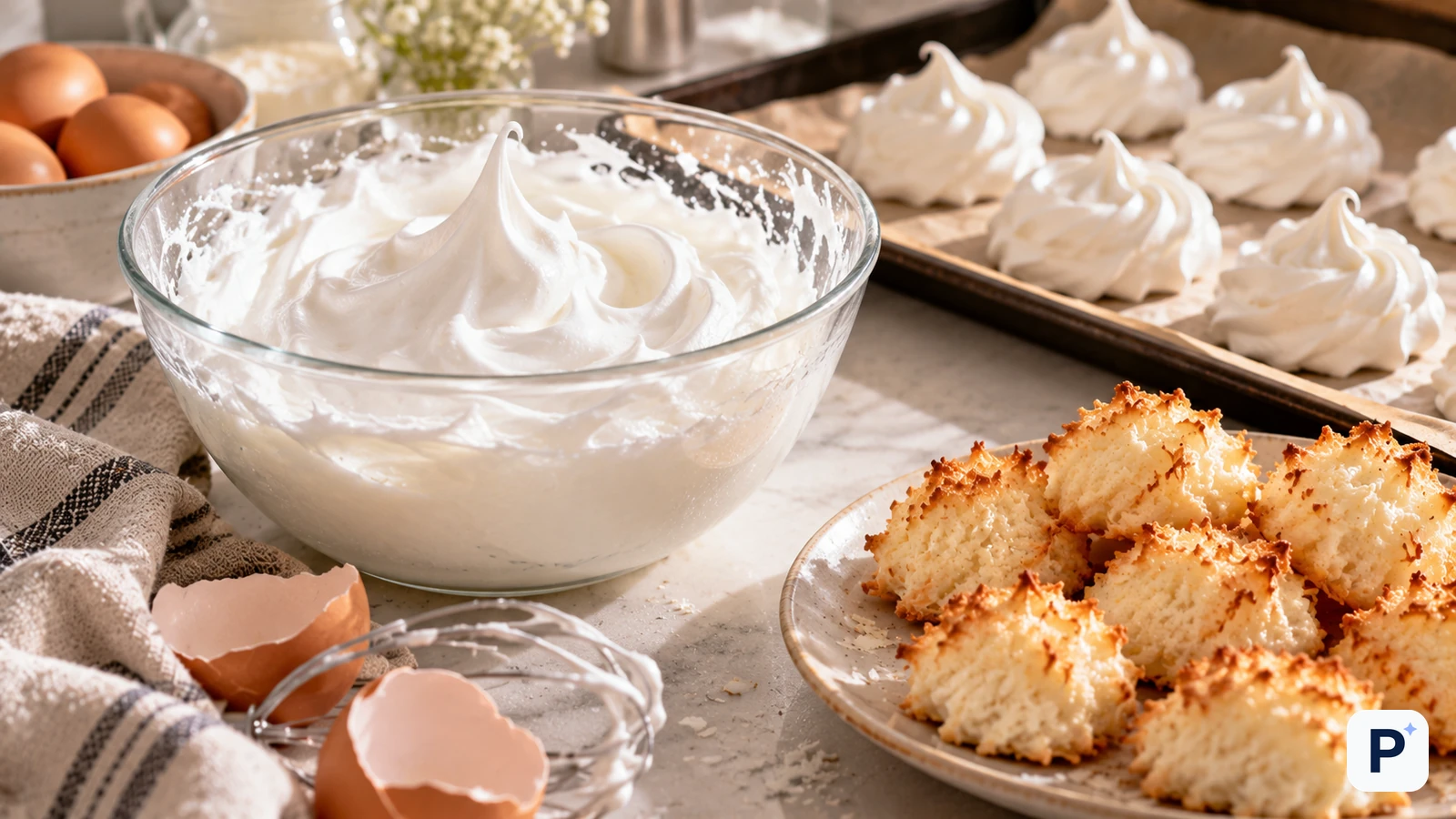
Coconut macaroons. Coconut macaroons are one of the simplest ways to use up a few egg whites. You combine the egg whites with desiccated coconut and sugar, shape small portions and bake them until lightly golden. You can make them plain or add vanilla, lemon zest or a little chocolate. They're a good choice when you have a few egg whites and don't want to spend an hour on a complicated dessert.
A small meringue. A few egg whites are also enough to make a small portion of meringue or little meringues. The base is egg whites and sugar whisked into a stiff foam. The sugar should be added gradually to achieve a stable, smooth mixture. You can use the finished mixture for small meringue kisses or one larger disc. A meringue takes more time than coconut macaroons, because once it's in the oven it is mainly dried out rather than baked quickly.
Little meringues. If you don't need a large dessert, make little meringues. This is a practical option partly because you can make a larger batch and keep the finished, dry meringues for a long time in the right conditions. They go well with fruit, whipped cream or ice cream, or they can simply be a sweet snack.
What to Do with 5–6 Egg Whites
With a larger amount, you can already prepare a dessert in which the egg whites are the main ingredient.
Pavlova. A pavlova is one of the most obvious ways to use a larger quantity of egg whites. You prepare a meringue base and, once it's baked, add cream or whipped cream and fresh fruit. One of its big advantages is that you can match the size to the number of egg whites you have. Got fewer? Make a smaller dessert. Got a lot? Make a bigger disc or several smaller ones.
Egg-white sponge. Egg whites can also be the base of a light sponge cake. This is a good idea if you have a lot left over after making a dessert or custard that uses only the yolks. The bake is fluffy precisely because of the egg-white foam, which is why the whisking technique matters a great deal here.
Angel food cake. Angel food cake is a light American cake whose characteristic base is, once again, egg whites. It is very fluffy and has a delicate structure. It's more of a suggestion for a larger quantity of egg whites than for quickly using up one or two.
Macarons: When You Have Lots of Egg Whites and Fancy a Bigger Project
Macarons are one of the more demanding ways to use up egg whites. The classic version uses egg whites, sugar and finely ground almonds. The number of ingredients itself is small, but the preparation requires precision.
You have to prepare the mixture correctly, pipe out even rounds and let them dry out properly before baking. That's why I wouldn't choose macarons just because you have a single bowl of egg whites left.
If you have a lot of them and you fancy baking, this is a brilliant way to use them up. If you just want to quickly get rid of two egg whites, an omelette or coconut macaroons will be far simpler.
Royal Icing
An egg white can also be used to make royal icing, used among other things for decorating biscuits and gingerbread. This is an interesting option if you have one egg white left and you happen to be planning some baking.
For uses in which the egg white stays raw, it's worth choosing pasteurised egg white or a product intended to be eaten raw, rather than using a random raw egg. Not every dish calls for this, though. In most bakes, the egg white will undergo heat treatment.
Egg Whites Don't Have to Be Just for Sweet Dishes
When you have a surplus of egg whites, it's easy to automatically think of meringue. Yet savoury uses are often far simpler. You can make:
- an omelette with vegetables and cheese,
- a frittata,
- vegetable fritters,
- breaded vegetables or meat,
- cutlets or meatballs, if the recipe calls for it,
- an addition to scrambled eggs or to an omelette made with whole eggs.
This matters especially if you don't fancy yet another sweet dessert. An egg white is, above all, an ingredient. It doesn't automatically have to end up as meringue.
What to Do with Egg Whites Left Over from Mayonnaise?
If you have egg whites left over after making mayonnaise, you have a few options.
If you have one or two, the simplest thing is to add them to an omelette, pancakes or another dish you are making anyway. If you have three or four left, you can make coconut macaroons or little meringues. If you have more, you can plan a pavlova or another bake based on egg-white foam. You can also keep them for later.
This is exactly why it's worth not making a decision under time pressure. Egg whites don't have to be used within an hour of separating the yolks.
How to Store Egg Whites in the Fridge
If you don't have an idea yet, you can store the egg whites. Transfer them to a clean, tightly sealed container and put them in the fridge. It's also worth writing the date on the container, so you don't later have to wonder when they were separated.
With home storage, it's best to use raw egg whites within a few days. If you know you won't manage it in time, freeze them instead of leaving them in the fridge for later.
Don't store them in an open bowl. Egg whites easily take on the smells of other products in the fridge.
Before using them, also check their appearance and smell. If they have an unusual, unpleasant smell or other signs of spoilage, don't try to salvage them.
Can You Freeze Egg Whites?
Yes. It's one of the best ways to deal with a larger quantity of egg whites that you don't want to use straight away. The most convenient method is to freeze them in portions.
If you bake often, you can freeze egg whites in batches of a few. If you don't yet know what you'll use them for, it's also handy to freeze them individually in small containers or moulds, and then transfer them to a larger container or bag.
Be sure to label the packaging with the date and the number of egg whites. That way, after a few weeks you won't have to guess what is actually inside.
Egg whites can be kept in the freezer for several months. Food-safety authorities give best quality for raw egg whites and yolks at around 12 months, although the shorter they are stored, the better for quality.
How to Thaw Egg Whites
The safest method is to move the frozen egg whites from the freezer to the fridge and let them thaw slowly. Don't thaw them on the kitchen counter or in warm water.
If you froze them individually, you can take out exactly as many portions as you need. Once thawed, use them according to the recipe.
If you want to learn more about the rules for safe thawing, read how to defrost food safely.
What to Do with Egg Whites Depending on How Many You Have
You can treat it like a simple cheat sheet:
- 1 egg white: a coating, pancakes, an omelette, an addition to a mixture.
- 2 egg whites: an omelette, pancakes, a small portion of a bake.
- 3–4 egg whites: coconut macaroons, little meringues, a small meringue.
- 5–6 egg whites: a pavlova, a larger meringue, an egg-white sponge.
- Lots of egg whites: a pavlova, a larger bake, macarons.
- No time? A sealed container and the fridge or the freezer.
It's simpler than writing down ten recipes you might never use.
The Best Approach? Plan Your Yolks and Whites Together
If you often make recipes that use only the yolks, you can think straight away about what you'll do with the egg whites. For example:
- mayonnaise leaves you with egg whites, and you can make an omelette with them the next day,
- a custard leaves you with egg whites, and you can make coconut macaroons with them,
- ice cream leaves you with egg whites, and you can make a pavlova with them,
- a cake made with yolks leaves you with egg whites, and you can make little meringues with them.
That way, you don't treat egg whites as a problem that appears after cooking. They're part of the plan from the start.
This works particularly well when baking. If you know a recipe will leave you with six egg whites, you can plan a dessert that needs exactly that many straight away.
Egg Whites Aren't Waste
The most important change is a simple one: don't treat egg whites as a by-product of the yolks. They're an ingredient you can use in many ways. And if it's the yolks you've been left with after making meringue or macarons, see what to do with egg yolks.
Got one? Add it to an omelette. Got two? Make pancakes or use them for a coating. Got four? Coconut macaroons or a small meringue. Got six? A pavlova or a larger bake. Got more than you can use? Freeze them.
So you don't have to work out a way to use egg whites at the exact moment you separate them from the yolks. You can simply note them down as a product to use and come back to them when you next plan your meals.
This is exactly where PantryOS can help. If you have egg whites left, you can add them to your inventory and later check what you have to use up, instead of discovering a forgotten container at the back of the fridge a few days later.