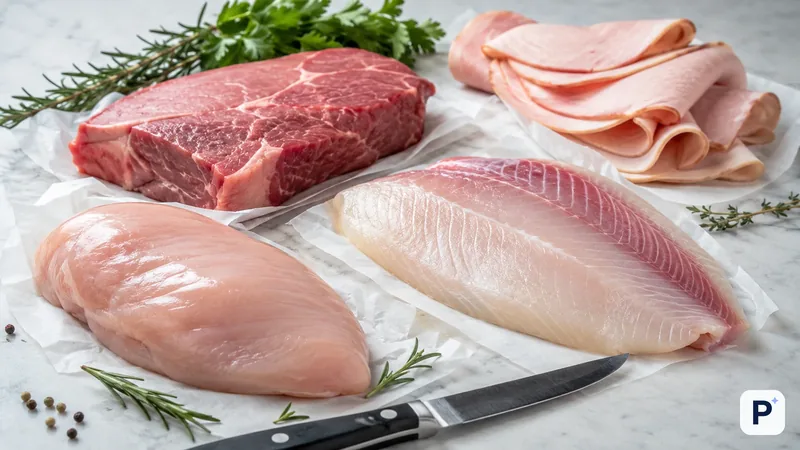
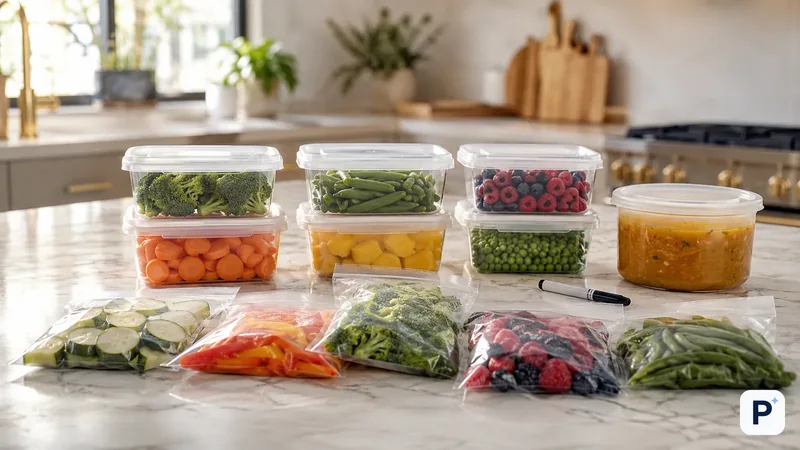
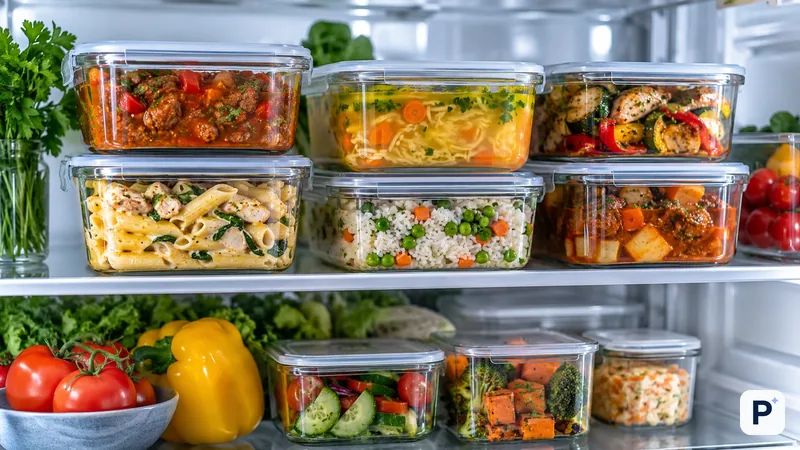
How to Defrost Food Safely: Fridge, Water or Microwave
Taking meat out of the freezer and leaving it on the worktop to "come round on its own" seems like the simplest way to defrost it. The problem is that during this kind of thawing, the outer part of the food can spend a long time at a temperature that encourages bacteria to multiply, while the centre is still frozen.
That is why the method you use matters. The safest option is the fridge, but when time is short you can also use cold water or a microwave. Each of these methods, though, has its own rules.
In this guide we show you how to defrost meat, fish and ready meals safely, when you can cook from frozen without thawing first, and what to do if a product has already defrosted but your plans have changed.
If you want to sort out the subject of freezing itself first, read our guide to what you can and can't freeze too.
Why Shouldn't You Defrost on the Worktop?
During defrosting, bacteria that may have been on the product before freezing can start to multiply again. Freezing does not sterilise food. After thawing, safety therefore depends partly on how long the product stays at a higher temperature.
On the kitchen worktop, the problem is that the product's temperature does not rise evenly. The surface defrosts much sooner than the centre. You can therefore have a piece of meat whose centre is still hard and frozen, while the outer layer is already warm.
That is why official guidance on safe defrosting advises against leaving food at room temperature. Food-safety authorities recommend defrosting in the fridge, and allow three safe methods: the fridge, cold water and the microwave.
The same applies to other seemingly convenient methods: hot water, a spot by the radiator, the windowsill or leaving the product in a warm kitchen.
Method 1: The Fridge
If you have time, the fridge is the best choice.
The product defrosts slowly, but stays at a low temperature throughout the process. This limits the growth of bacteria, and once thawed you can keep the product in the fridge for a certain time rather than being forced to cook it immediately. Food-safety authorities also point to defrosting in the fridge as the safest method.
The simplest pattern looks like this: you take it out in the evening, move it to the fridge, and cook it the next day.
Large pieces may need considerably more time. Small portions of meat can defrost within 24 hours, while larger cuts, such as a big roasting joint, may need two days or longer. Official guidance notes, for example, that large cuts of beef can take two days or longer to defrost.
Where Should You Put Meat That Is Defrosting?
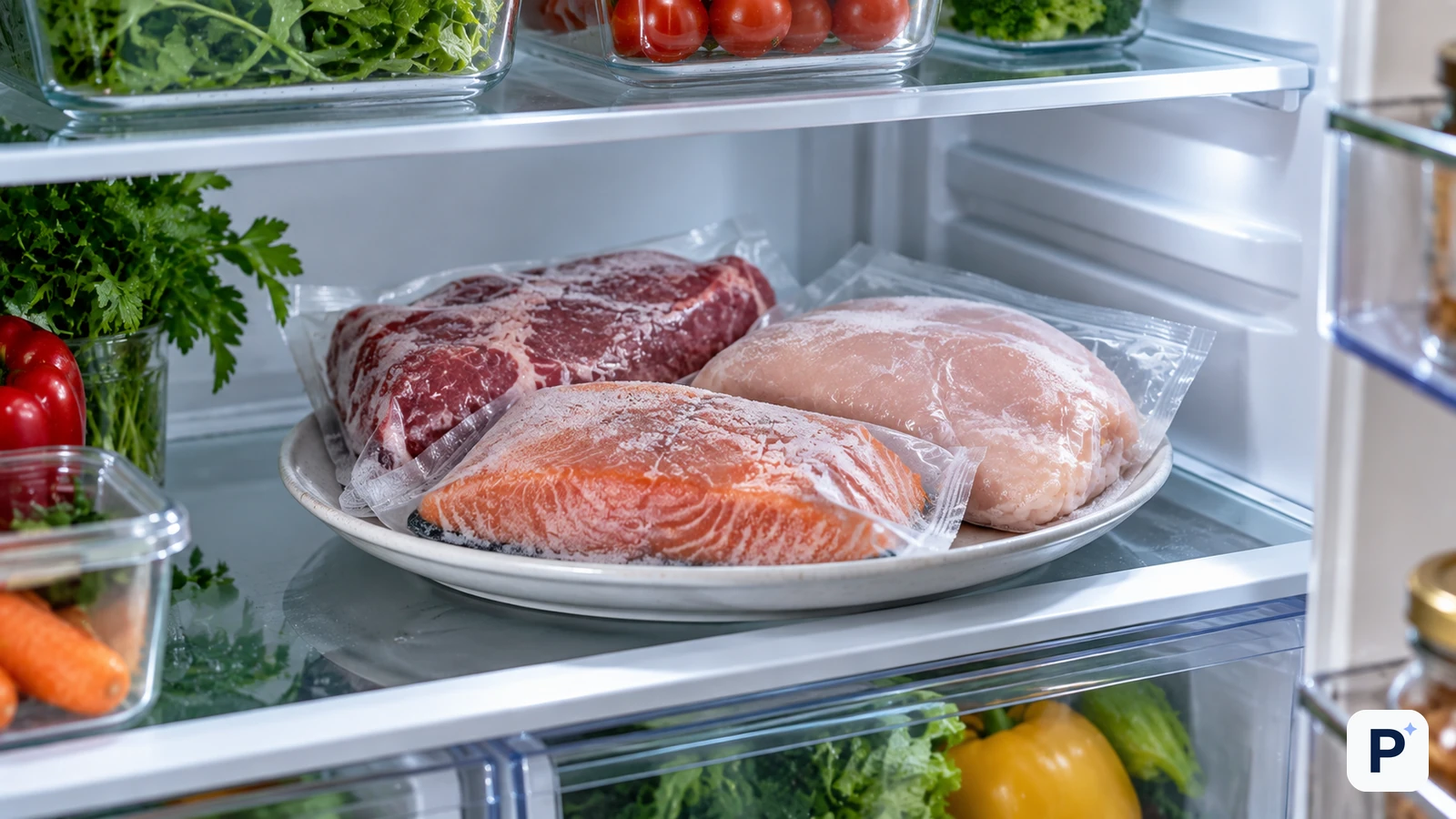
Raw meat, fish and poultry are best placed in a container or on a plate that will catch any leaks, and kept so that they do not come into contact with ready-to-eat products.
The bottom shelf of the fridge works well. If liquid leaks from the packaging, it should not get onto lettuce, cheese or ready-to-eat food.
It is also worth leaving the product in airtight packaging or transferring it to a suitable container. Food-safety authorities recommend storing defrosting food in its original packaging or a suitable clean container to limit the risk of contamination.
Method 2: Cold Water
If you forgot to move the meat to the fridge the day before, you can use cold water.
This method is quicker, but calls for more attention. Official guidance recommends keeping the frozen product in sealed, leak-proof packaging or a bag. You then submerge it in cold water and change the water roughly every 30 minutes, so that it stays suitably cold throughout.
So it is not a case of dropping the meat into a bowl of water and leaving it there unattended for several hours.
The pattern is simple: sealed packaging, cold water, change the water about every 30 minutes, cook immediately once defrosted.
Official guidance stresses that food defrosted using the cold-water method should be cooked before it is refrozen.
It is also important not to use warm or hot water. Faster does not always mean safer. Heat can warm the surface of the product while its centre remains frozen.
Method 3: The Microwave
The microwave works well when the food is to be prepared almost straight away.
Use the defrost programme or a low power setting in line with your appliance's instructions. During defrosting, it is worth turning the product or separating its pieces where possible.
Why the rush? A microwave does not always heat a product evenly. Some parts may already be starting to warm up or cook, while others remain frozen. That is why official guidance recommends that food defrosted in the microwave be cooked or otherwise heat-treated straight away.
So don't defrost meat in the microwave in the morning to use it only in the evening. The microwave is a "for now" method.
Cold Water or Microwave?
Both methods are useful, but in slightly different situations.
If you have a few hours, or can plan a meal the day before, choose the fridge. If you need to defrost a larger portion more quickly and you can keep an eye on the product, cold water will do the job. If dinner needs to be ready right away and you have no time for lengthy defrosting, you can use the microwave.
The most important rule is simple: the quicker the method, the less you can afford to put the product off "for later".
Can You Cook from Frozen?
Yes. You don't always have to defrost a product at all.
Many frozen products can be prepared straight from the freezer. This includes, among others, frozen vegetables, some fruit intended for cooking or baking, pierogi, some ready meals and products for which the manufacturer clearly states that they can be prepared without defrosting. Food-safety authorities also recommend checking the instructions on the packaging, because some products can be safely cooked without thawing first.
This is often the best solution for everyday cooking. Got frozen peas? You don't need to defrost them. Got a portion of frozen soup? You can heat it through using the appropriate method. Got frozen stir-fry vegetables? They usually go into the pan straight from the freezer.
With raw meat and fish, it depends more on the product. A thin piece may be suitable for cooking from frozen, but a thick piece may need considerably more time and be harder to cook evenly in the centre.
That is why, with meat, you should first check the manufacturer's instructions, and while cooking make sure the product is properly done in the centre too.
Can You Defrost Something and Cook It Only the Next Day?
If the product defrosted in the fridge, you don't have to cook it immediately.
You can keep it in the fridge for longer, but the time depends on the type of product. According to official guidance, after defrosting in the fridge, mince, poultry and fish should be used or refrozen within 1–2 days. For beef, pork, lamb or veal in pieces, the recommended period is 3–5 days.
This does not mean, however, that every product can automatically be kept for the same length of time after defrosting. Always check the manufacturer's instructions and the markings on the packaging.
With ready meals, it also matters how they were stored before freezing and what storage rules the manufacturer gives.
Can You Refreeze Food That Has Been Defrosted?
This is where the rule often comes up: "never refreeze something once it has thawed". As a simple rule for all situations, it is too absolute.
If raw or cooked food defrosted in the fridge, official guidance considers refreezing it safe. The main issue may be quality: after another cycle of freezing and thawing, the product may be drier, softer or less appealing in flavour and texture.
If, on the other hand, the product was defrosted in cold water or in the microwave, it should be cooked first, and only then can you freeze the finished dish.
There is also an important limit: if food has been out of the fridge for more than about 2 hours, it should not be refrozen just because it looks or smells normal. Official guidance clearly advises against refreezing food that has been out of the fridge for longer than 2 hours.
The Simplest Rule
- Defrosted in the fridge: can be refrozen.
- Defrosted in water: cook first, then you can freeze.
- Defrosted in the microwave: cook first, then you can freeze.
- Left on the worktop for a long time: do not refreeze.
It is worth noting that European consumer advice can be more cautious. In its defrosting guidance, food-safety authorities recommend not refreezing thawed food and always following the manufacturer's instructions. So if the packaging of a particular product carries more restrictive advice, that is what you should follow.
What If a Product Is Only Partly Defrosted?
You don't have to throw it away automatically.
If the product still contains ice crystals, or its temperature remains at around 4°C or lower, official guidance considers it suitable for refreezing. The quality may suffer, though.
This is useful information after a short power cut, for example, or when you take a product out of the freezer and then change your mind.
Don't judge safety by smell or appearance alone, though. If you are not sure how long the product stayed at an unsafe temperature, caution matters more than trying to rescue it.
How to Defrost Specific Products
Different groups of products follow slightly different rules.
Meat
It is best to move it from the freezer to the fridge the day before. Larger pieces may need more time.
Once defrosted, keep raw meat separate from ready-to-eat food, ideally in a container that will protect the fridge from leaking liquid.
If you need a quick solution, use cold water or the microwave and prepare the meat straight after defrosting.
Fish
Fish is more delicate and loses quality quickly, so it is also best defrosted slowly in the fridge.
Food-safety authorities recommend defrosting meat, fish and seafood on a tray in the fridge, to limit the risk of contaminating other products.
If you buy frozen fish or seafood, always check the instructions on the packaging too.
Ready Meals
Soups, sauces, stews and other ready dishes can be defrosted in the fridge and then heated through thoroughly.
If you need a faster option, you can use the microwave in line with your appliance's instructions. With microwave defrosting, the dish should then be heated through and eaten straight away, or only chilled once it has been cooked. Official guidance recommends that food defrosted in the microwave be heat-treated immediately after thawing.
Vegetables and Fruit
Here there is usually no need to defrost at all.
Frozen vegetables can usually go straight into a pot, a pan or the oven, unless the manufacturer recommends otherwise. Fruit can go straight into a smoothie, porridge, a cake or a cooked sauce.
Food-safety authorities also note that some vegetables and fruit can be defrosted under cold running water, ideally in their original packaging.
The Most Common Defrosting Mistakes
"I'll take it out in the morning and it'll be ready by the evening." Don't leave raw meat or fish on the worktop all day. Instead, move it to the fridge the evening before.
"Warm water will speed things up." Don't use hot water to defrost. If you choose water, it should be cold, the product should be sealed tightly, and the water should be changed regularly.
"I'll defrost it in the microwave and cook it later." No. The microwave is a method for situations where you'll prepare the product straight after defrosting.
"Once I've defrosted it, I have to throw it away." Not always. A product safely defrosted in the fridge can, according to official guidance, be refrozen, although its quality may deteriorate.
"There's no need to plan, you can always defrost something quickly." You can, but the fridge is still the simplest method if you have time. It's enough to take out a portion in the evening for the next day.
The Best Way to Defrost Safely? Plan It in Advance
In practice, many defrosting problems start with a single sentence: "Oh, I forgot to take the meat out." Then come the worktop, the warm water, or an attempt to defrost everything in the microwave just before dinner.
The simplest solution is to portion products before freezing. Instead of freezing a kilo of meat in one large piece, divide it into portions matching one or two meals. Smaller portions defrost more quickly and make it easier to use exactly as much as you need.
The second thing is planning. If you know you want to make chicken curry tomorrow, you take a portion of chicken out of the freezer in the evening and move it to the fridge. If you're planning a soup, you can take out the right portion in advance. If you don't yet know what you'll cook, but you can see in the app that you have a few products in the freezer, you can factor them into your plan for the coming days.
This is where PantryOS comes in handy. You can keep track of the products you have at home, including supplies kept in the freezer, and plan meals based on what you already have.
That way, defrosting stops being an emergency task. It simply becomes one of the steps in getting dinner ready.
Remember These Four Rules
If you don't want to memorise the whole article, four things are enough:
- Defrost in the fridge for the greatest safety.
- If you're in a hurry, use cold water or the microwave, following the rules.
- Don't defrost raw meat and fish on the kitchen worktop or in hot water.
- The defrosting method also decides whether you can later refreeze the product.
Above all, though, it comes down to planning. If you take exactly the portion you need out of the freezer, and do it early enough, you don't have to choose between safety and convenience.