How to Store Potatoes So They Don't Sprout or Turn Green
Potatoes seem like one of those foods you can simply throw into a cupboard and forget about. In practice, when stored badly they soon begin to sprout, turn green, go soft or rot.
That doesn't always mean you have to throw them away straight away, though. In many cases the problem starts much earlier: the potatoes are kept somewhere too warm, they're exposed to light, or they're sealed in an airtight plastic bag.
Good storage comes down to a few simple rules: cool, dark, dry and with access to air.
In this article we look at where it's best to keep potatoes, why the fridge isn't always a good place for them, what you shouldn't store next to them and what to do when the first sprouts or green patches appear.
This is part of our series on storage. You'll find the general rules in our guide to how to store fruit and vegetables, but potatoes deserve a discussion of their own.
Cool, Dark, Dry and Airy
If you want potatoes to keep their quality for a long time, remember four words: cool, dark, dry, airy.
Cool slows down sprouting. Darkness protects against greening. A dry environment limits the risk of rot, and access to air prevents moisture from building up.
Ideal conditions are easier to achieve in a cellar or a cool pantry than in a typical kitchen. For potatoes meant for longer storage, a temperature of around 7–10°C is often suggested, though the optimal conditions also depend on the variety and the intended use of the potatoes.
In a home setting, what matters most is simply that it isn't very warm and that the potatoes aren't exposed to light.
A good spot might be, for example:
- a cool, dark pantry,
- a cellar,
- a cool cupboard away from the oven and the radiator,
- an airy basket placed in a shaded spot.
Don't store potatoes on a windowsill, on a worktop by the window, or anywhere that light falls for most of the day.
What to Store Potatoes In
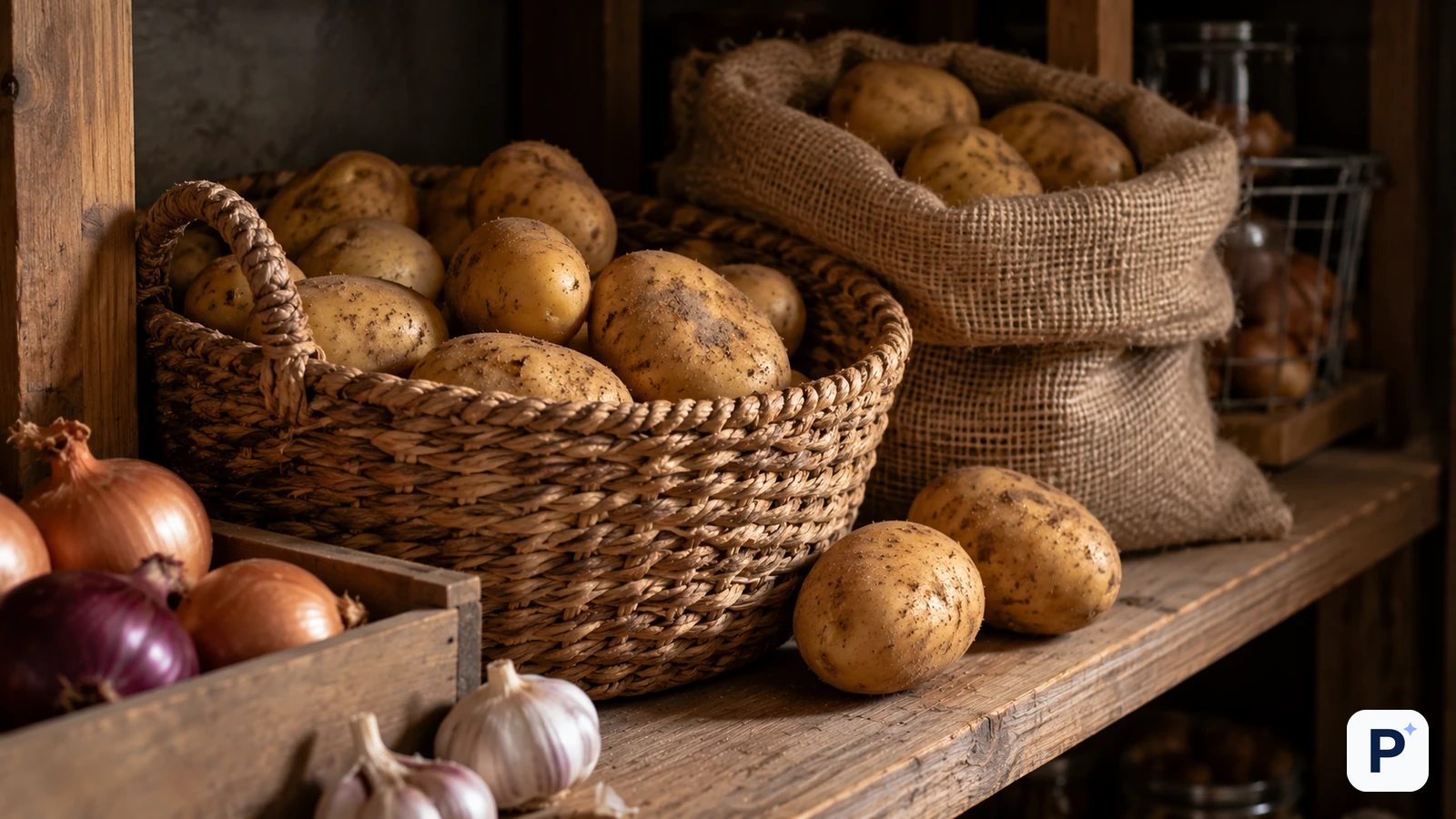
Potatoes need access to air, which is why they don't do well in a tightly sealed plastic bag. A better choice is:
- a paper sack,
- a hessian sack,
- a wooden crate,
- an airy basket,
- a container with ventilation holes.
Don't wash potatoes before storing them for any length of time. Moisture on the surface can speed up spoilage. If they're covered in soil, it's better to clean them off dry and wash them only before you prepare them.
Why the Fridge Isn't Always the Best Place for Potatoes
This is one of the more complicated questions, because the answer isn't simply 'never'.
At very low temperatures, particularly below around 7°C, potatoes can develop a higher content of sugars formed from the breakdown of starch. As a result, after frying or roasting the potatoes may brown faster and more deeply.
That's why, for long-term storage of raw potatoes, the fridge isn't the first choice if you have access to a cool, dark and airy place.
But what should you do if you live in a very warm flat with no pantry or cellar? Then the most important thing is to find the coolest, darkest spot you have. It's also not worth buying large quantities of potatoes to stockpile just because they can, in theory, keep for a long time.
Cooked potatoes, on the other hand, are stored differently. Cooked potatoes should be cooled and kept in the fridge in a sealed container, following the rules for storing cooked food.
Don't Keep Potatoes Next to Onions
Potatoes and onions often sit side by side in the kitchen, because both are associated with similar storage conditions. It's better, though, not to mix them.
Onions and potatoes have different storage requirements, and keeping them together can speed up the deterioration of both. Potatoes should have their own spot, ideally well away from onions.
It's also worth being careful with other foods kept nearby. Ripening fruit gives off ethylene, which affects the processes taking place in various fruit and vegetables. So it's not a good idea to create one big crate holding potatoes together with fruit and onions.
The simplest solution is the best: store potatoes separately, in a dark and airy place.
What to Do When Potatoes Start to Sprout
Sprouts are a sign that a potato is beginning to age and is preparing to grow a new plant. The process is sped up above all by warmth and exposure to light.
If a potato is still firm and has only small sprouts, you can remove them carefully, cutting out the part of the potato directly around the sprout as well. It's worth doing this thoroughly, because glycoalkaloids, including solanine, can build up in the area around the sprouts.
It isn't enough, though, to adopt the rule that 'any potato with a sprout should be thrown away'. What matters is its overall condition. If a potato:
- is firm,
- has no mould,
- isn't rotting,
- has no large green areas,
- has only small sprouts,
then you can remove them and use the potato.
If, on the other hand, it's heavily sprouted, very wrinkled, soft, green or bitter, it's safer to throw it away. Don't try to rescue a potato just because it 'seems a shame to bin it', either. If its quality has clearly deteriorated, that's a sign it has been stored for too long.
Green Potatoes: When Not to Eat Them
Greening in potatoes is more than just a cosmetic problem.
The green colour develops under the influence of light and is often accompanied by a raised concentration of glycoalkaloids, chiefly solanine and chaconine. In larger amounts these substances can cause symptoms of poisoning, including gastrointestinal upset.
That's why green potatoes shouldn't be treated the same way as ordinary, lightly sprouted ones.
If only a small part is green, you can cut it out very thoroughly and generously along with the surrounding flesh, and use the rest, provided the potato is firm and shows no other signs of spoilage.
If, however, the potato is very green, bitter, or the greening covers a large part of the surface, it's better to throw the whole thing away.
Don't assume, either, that boiling, frying or roasting automatically solves the problem. Cooking is not a way to 'neutralise' a large amount of glycoalkaloids. The best method of preventing greening is simply a dark storage place.
What If a Potato Is Green Only Under the Skin?
This is a situation where it's worth being cautious.
If, after peeling off a small piece, you notice green discolouration, remove it along with a suitably large margin of flesh. If the green colour is extensive or the potato has a bitter taste, don't try to use the rest.
With potatoes it's not worth relying solely on the rule 'I'll cut a bit off and it'll be fine'. The larger the green area, the greater the reason to throw the potato away.
How Long Can You Store Potatoes?
There's no single figure that's right for all potatoes. The variety, the time of harvest, how they were prepared for storage, the temperature, the humidity and the conditions in your home all make a difference.
Potatoes meant for longer storage can, in the right conditions, keep their quality for many weeks, and properly stored late varieties even for several months. New potatoes usually have a much shorter shelf life and are best used sooner.
In a flat that's around 20°C for most of the year, it's hard to give potatoes ideal conditions for long storage. In that case, a better strategy may be to buy smaller amounts. Instead of a big sack, buy as much as you'll realistically use over the next few weeks.
Check Your Stock Regularly
If you're storing a larger quantity of potatoes, don't just tip them into a crate and leave it untouched for a month. Every so often it's worth doing a quick check. Remove any that:
- are starting to rot,
- are very soft,
- have mould,
- have become badly wrinkled,
- are very green.
That way, one spoiled potato won't sit next to the rest for a long time.
It's also a good habit not to mix freshly bought potatoes with your older stock. Use the older ones first, and only then reach for the new. It's the simple 'first in, first out' rule, and it works not only in a restaurant kitchen but in a home pantry too.
Got a Lot of Potatoes? Plan What You'll Cook
The best way to avoid wasting potatoes is to use them before they start to lose quality noticeably.
Potatoes are exceptionally versatile in this respect. Among other things, you can make:
- mash,
- roast potatoes,
- pan-fried potatoes,
- potato pancakes,
- kopytka (Polish potato dumplings),
- Silesian dumplings,
- a potato bake,
- potato soup,
- a filling,
- potato salad.
If you can see you've got more than you can use in a single week, don't wait until they all start to sprout. Plan a few meals that will use up a larger batch. We've gathered more ideas in our guide to what to do with potatoes.
It's this kind of planning that's often more effective than looking for a way to rescue food later on.
The Most Important Rules for Storing Potatoes
If you only want to remember a few things, let it be these. Keep potatoes:
- in the dark,
- somewhere cool,
- in dry conditions,
- with access to air,
- away from onions and other foods that can worsen their quality.
Don't do this:
- don't leave them in the light,
- don't store them in an airtight plastic bag,
- don't keep a large stock in a warm kitchen,
- don't eat potatoes that are very green or clearly spoiled.
When small sprouts appear: remove them thoroughly and assess the whole potato. When a potato is very green, bitter, soft or spoiled: throw it away.
Good Storage Starts with What You Already Have
Potatoes don't need a complicated system. They need the right place and regular checks on your stock.
The biggest problem usually isn't that potatoes didn't last long enough. The problem arises when we buy more than we can use and then forget about them in the pantry.
That's why it's worth combining good storage with planning. In PantryOS you can keep information about the foods you have at home and keep track of your stock, which makes it easier to notice that certain foods need to be used up first.
Because a potato is easiest to rescue not when it's already heavily sprouted, but a few weeks earlier, when you simply remember that you have it.