How Much Food Per Person: Potatoes, Pasta, Rice and Meat
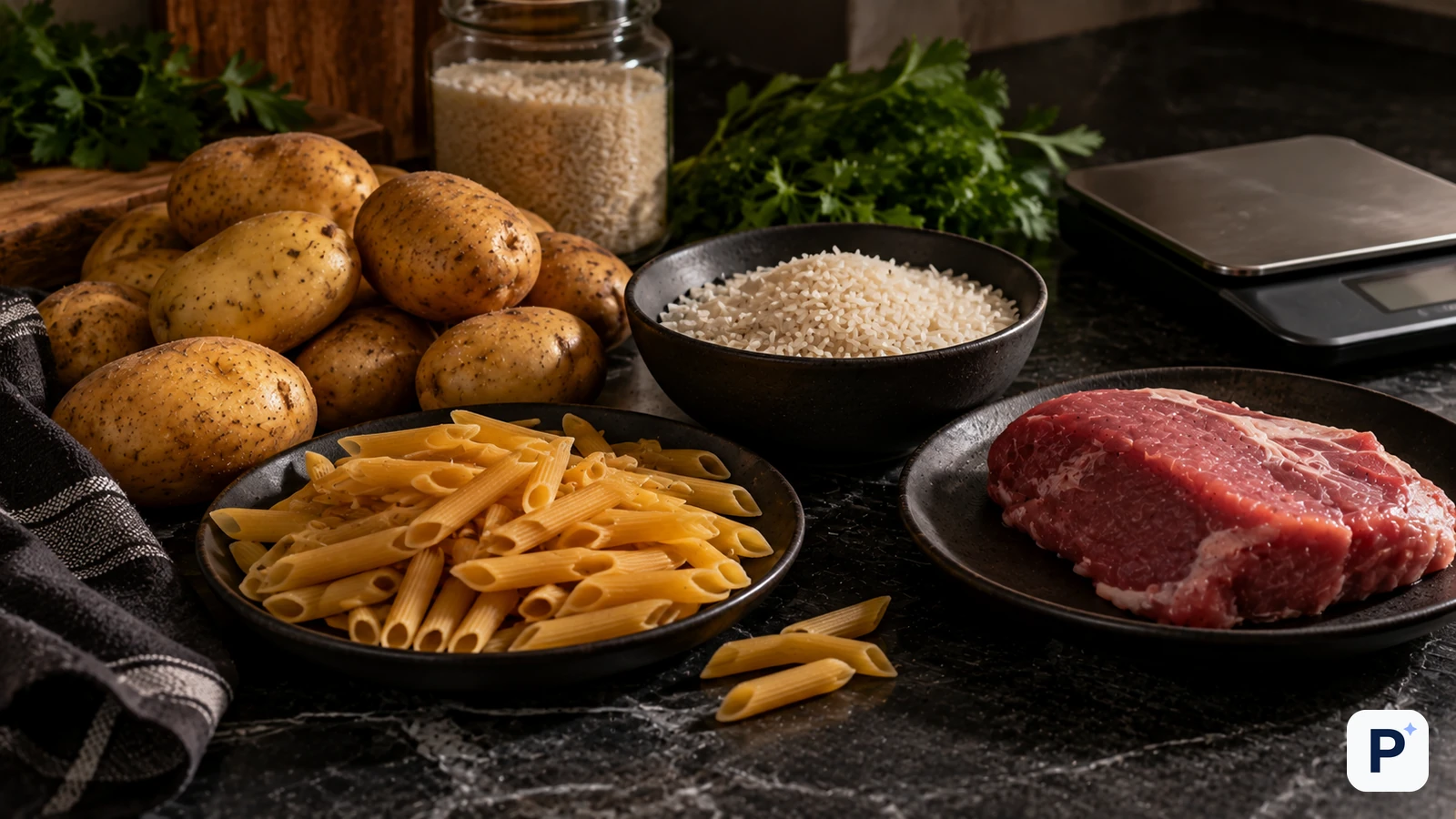
How many potatoes should you cook for a dinner for four people? How much pasta for two? And how much rice if there is also meat and a side salad alongside it?
These are some of the most common questions in the kitchen, and at the same time a frequent source of food waste. Cook too much and you end up with leftovers that are easy to forget about. Prepare too little and you have to rush to make another portion.
There is no single perfect portion for everyone, but you can work with rough amounts that serve well as a starting point.
In this guide you will find conversions for potatoes, pasta, rice, groats and meat, along with tips on how to reduce or increase a portion depending on who will be eating and what else is on the table.
If you don't want to work everything out yourself, you can go straight to our portion calculator. Choose the number of people and the products, and you will get a rough amount to prepare.
How Many Potatoes Per Person?
As a side dish, you can allow around 200–250 g of raw, peeled potatoes per person.
In terms of whole potatoes, that usually works out to around 3–4 medium potatoes, but treat this conversion as a rough guide. Potatoes can vary a great deal in size, so for larger numbers of people, weighing them will be more accurate.
For example:
- 1 person: around 200–250 g,
- 2 people: around 400–500 g,
- 4 people: around 800 g to 1 kg,
- 6 people: around 1.2–1.5 kg.
If potatoes are only one of several side dishes, you can prepare less. If, on the other hand, they make up a large part of the meal, for example if you serve them with plain meat and one vegetable side, something closer to 250 g per person will be a more sensible starting point.
And How Many Potatoes for Mash?
For mash, it is often worth preparing around 250 g of raw potatoes per person, because during preparation you also add milk, butter or other extras, and the potatoes are often one of the main parts of the meal.
That doesn't mean you always have to prepare exactly that amount, though. If the mash is just a side dish for a large dinner, you can go lower.
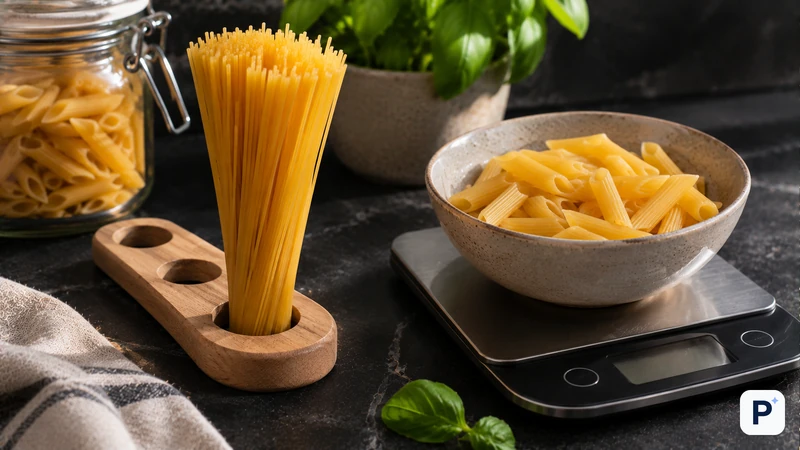
How Much Pasta Per Person?
With pasta, the most important thing is whether it is the main ingredient of the dish or just a side.
As a main course, for example pasta with sauce, you can allow around 80–100 g of dry pasta per person.
As a side to meat or another dish, around 50–60 g of dry pasta per person is usually enough.
As a rough guide, it looks like this:
- 1 person: 80–100 g,
- 2 people: 160–200 g,
- 4 people: 320–400 g,
- 6 people: 480–600 g.
Pasta increases in weight during cooking because it absorbs water. Depending on the type and cooking time, its weight can increase by around two and a half times, which is why 100 g of dry pasta does not mean 100 g of the finished product.
That is exactly why it is easy to overestimate the amount you need when you measure pasta by eye.
An Example for a Family
If you are cooking dinner for two adults and two children, you don't automatically have to prepare 400 g of pasta.
If the children eat smaller portions, you can start, for example, with around 250–300 g of dry pasta and adjust the amount to the age and appetite of your household.
How Much Rice Per Person?
Rice also increases in volume considerably during cooking, so it is easy to prepare too much.
As a main course, you can allow around 60–80 g of dry rice per person.
As a side to meat, curry or vegetables, around 40–60 g of dry rice per person is usually enough.
For example:
- 1 person: 60–80 g,
- 2 people: 120–160 g,
- 4 people: 240–320 g,
- 6 people: 360–480 g.
Once cooked, rice can weigh around 2–3 times more than it did before cooking, depending on the variety and the method of preparation. That is why, instead of assuming one fixed conversion, it is better to treat the values as a range.
If you are preparing rice for a curry that contains plenty of meat, vegetables and sauce, you probably need less of it than when the rice is the basis of the whole dish.
How Much Groats Per Person?
You can work out groats much as you would rice.
For most groats, as a side dish for dinner, a good starting point is around 50–70 g of dry groats per person.
If the groats are the basis of the dish, for example in a bowl with vegetables and meat, you can allow around 60–80 g.
This applies to buckwheat, millet and bulgur among others, although each variety behaves slightly differently during cooking.
As with rice, it is not worth going by the volume after cooking alone. The easiest approach is to measure out the dry product before cooking.
How Much Meat Per Person?
For meat as the main part of dinner, you can allow roughly 120–150 g of raw, boneless meat per person.
This, however, is one of the values that depend most on the type of dish and the appetite.
For example:
- chicken breast: around 120–150 g per person,
- minced meat for a sauce: around 100–150 g per person,
- a piece of meat in a dish with plenty of vegetables: often less is enough,
- meat in a one-pot dish: the amount can be reduced, because the meat is only one of the ingredients.
And What About Meat on the Bone?
Here you need to count more, because part of the weight you buy is bone.
If you are buying thighs, drumsticks, wings or other cuts on the bone, 120–150 g of the product does not mean 120–150 g of meat on the plate.
In that case, you need to increase the amount depending on the type of cut.
That is why, when shopping, it is best to check whether the stated portion refers to the edible product or to the product by weight including the bone.
How Much Food Should You Prepare for a Child?
A child doesn't automatically need half an adult portion. The amount depends above all on age, appetite and what else is in the meal.
For younger children, portions will be noticeably smaller, while older children can eat considerably more.
Rather than using a fixed conversion, it is better to start with a smaller portion and top it up if needed.
This is a particularly good way to reduce waste. A second helping is easier to manage than a plate that nobody has eaten.
A Quick Cheat Sheet: How Much to Prepare Per Person?
Treat the values below as a starting point for an adult.
| Product | Main course | As a side |
|---|---|---|
| Potatoes | approx. 250 g | approx. 200–250 g |
| Pasta, dry | 80–100 g | 50–60 g |
| Rice, dry | 60–80 g | 40–60 g |
| Groats, dry | 60–80 g | 50–70 g |
| Boneless meat, raw | 120–150 g | depends on the dish |
These are not nutritional standards or compulsory portions. They are practical starting values that you can increase or decrease.
If you want to calculate a specific amount for your family, instead of multiplying the values in your head, you can use the PantryOS portion calculator.
How to Adjust a Portion to a Specific Dinner?
The biggest mistake when working out portions is treating every dinner the same.
Picture two meals.
The first is a large steak, a small amount of vegetables and potatoes.
The second is chicken curry with plenty of vegetables, sauce and rice.
In both cases you don't need the same amount of potatoes, rice and meat.
So before cooking, ask yourself a few questions.
What Is the Main Ingredient?
If pasta is the base of the whole dish, prepare more of it.
If it is just a side to plenty of sauce, vegetables and meat, you can prepare a smaller portion.
How Many Other Products Will Be on the Plate?
The more components in the meal, the less you need of each one.
A dinner made up of soup, meat, potatoes and two side salads will call for a smaller portion of potatoes than a simple plate of meat and potatoes.
Who Will Be Eating?
Not everyone in the household has the same appetite.
A teenager may eat considerably more than a small child. Someone who has just come back from an intense workout may need a larger meal than someone with a small appetite.
That is why, when cooking for a family, it is not worth multiplying one portion by the number of people without any adjustment.
Is It Better to Cook Too Little or Too Much?
If you are torn between two amounts, it is often better to start with the smaller one.
With many products, it is easy to prepare a second helping, but much harder to undo cooking a whole pot of pasta or rice.
This is especially true for products that quickly lose quality after cooking, or that are later difficult to use in another form.
A good approach is to prepare a small buffer for a larger group of people, but not a huge supply "just in case".
If some food is left over, plan how to use it the next day.
Cooked rice can go into fried rice. Potatoes can be turned into potato dumplings or pancakes. Pasta can be combined with a new sauce. Meat can go into a wrap, a salad or a bake.
That way, a surplus doesn't automatically have to mean waste.
How to Scale a Portion Up for More People?
If you are cooking for a larger group, start with the portion for one person and multiply it by the number of people.
Example: you want to prepare pasta with sauce for 6 adults.
At 90 g of dry pasta per person:
6 x 90 g = 540 g of dry pasta.
If, however, the sauce contains plenty of meat, vegetables and other ingredients, you can opt for the lower end of the range.
For 4 people at 70 g of rice as a side:
4 x 70 g = 280 g of dry rice.
And for 5 people at 130 g of boneless meat:
5 x 130 g = 650 g of raw meat.
It is precisely these simple calculations that let you avoid cooking by eye.
Work It Out Exactly for Your Number of People
Rough portions are handy when you quickly want to check whether you need half a kilogram or a kilogram of a product.
But when you are cooking for a specific number of people, it is more convenient to simply work everything out automatically.
The PantryOS portion calculator lets you match the amount of food to the number of people and the type of meal you are preparing.
Instead of multiplying 80 g by 5 people in your head, and then wondering whether you also need 300 or 400 g of vegetables to go with it, you can do it all in one place.
This is especially useful for:
- cooking for the whole family,
- larger gatherings,
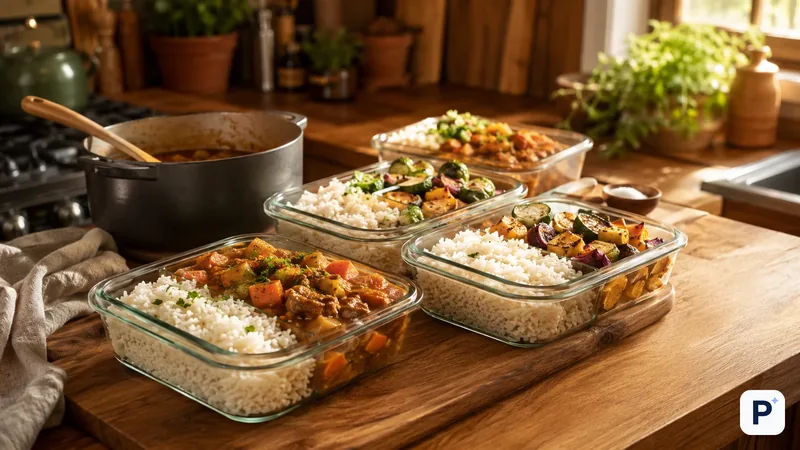
- preparing dinner for several days,
- planning your shopping,
- meal prep,
- cooking on a limited budget.
The most important thing, however, is that a portion should be a starting point, not a rigid limit.
Over time you will notice how much your household eats, and it will be easier to adjust amounts without weighing every ingredient.
The Best Portion Is the One You Will Actually Eat
Working out portions isn't about making every plate look identical.
It is about reducing the situations where you cook twice as much as you actually need, and then half the dinner ends up in the fridge and is forgotten.
Start with a rough amount, adjust it to the appetite and the nature of the dish, and if you are not sure, prepare a little less and leave room for a second helping.
Because one of the simplest ways to reduce food waste is not to look later for a way to use up a huge amount of leftovers, but to cook from the start only as much as you really need.