What to Do with Stale Bread: Ideas Instead of Throwing It Away
Has your bread turned hard and dry, and you no longer fancy eating it? Don't throw it out straight away.
Stale bread is not the same as spoiled bread. If the loaf is only dry and hard, with no mould, strange smell or other signs of spoilage, you can still use it in plenty of ways. What's more, for some dishes stale bread works even better than fresh.
Dry slices are excellent at soaking up egg mixture, sauces and the juices from vegetables. You can also grind them, toast them, soak them or use them as the base of a whole dish.
So instead of asking "is this bread still good to eat?", it's sometimes worth asking a different question: "what can I make with it?".
Below you'll find a dozen or so ideas, from the simplest croutons to a full dinner.
First Check: Stale or Mouldy?
This is the most important distinction.
Stale bread is hard and dry, it may crumble, and it is no longer as pleasant to eat as fresh bread. If there are no signs of mould and it smells normal, you can use it.
Mouldy bread cannot be salvaged. If you see a green, white, black or otherwise suspicious coating on the bread, the whole thing should go in the bin. It is not enough to cut off the slice with the visible mould. Bread is porous, so the mould can reach deeper than you can see on the surface. Food safety authorities recommend throwing away bread and baked goods once mould has appeared on them.
Don't try to "rescue" such bread either, by toasting it in the oven or turning it into croutons.
If the bread is simply dry and hard, the situation is completely different. Use it if it's stale, bin it if it's mouldy.
For more on how to tell loss of freshness apart from spoilage, see our guide on how to recognise when food has gone off.
1. Croutons: The Simplest Option
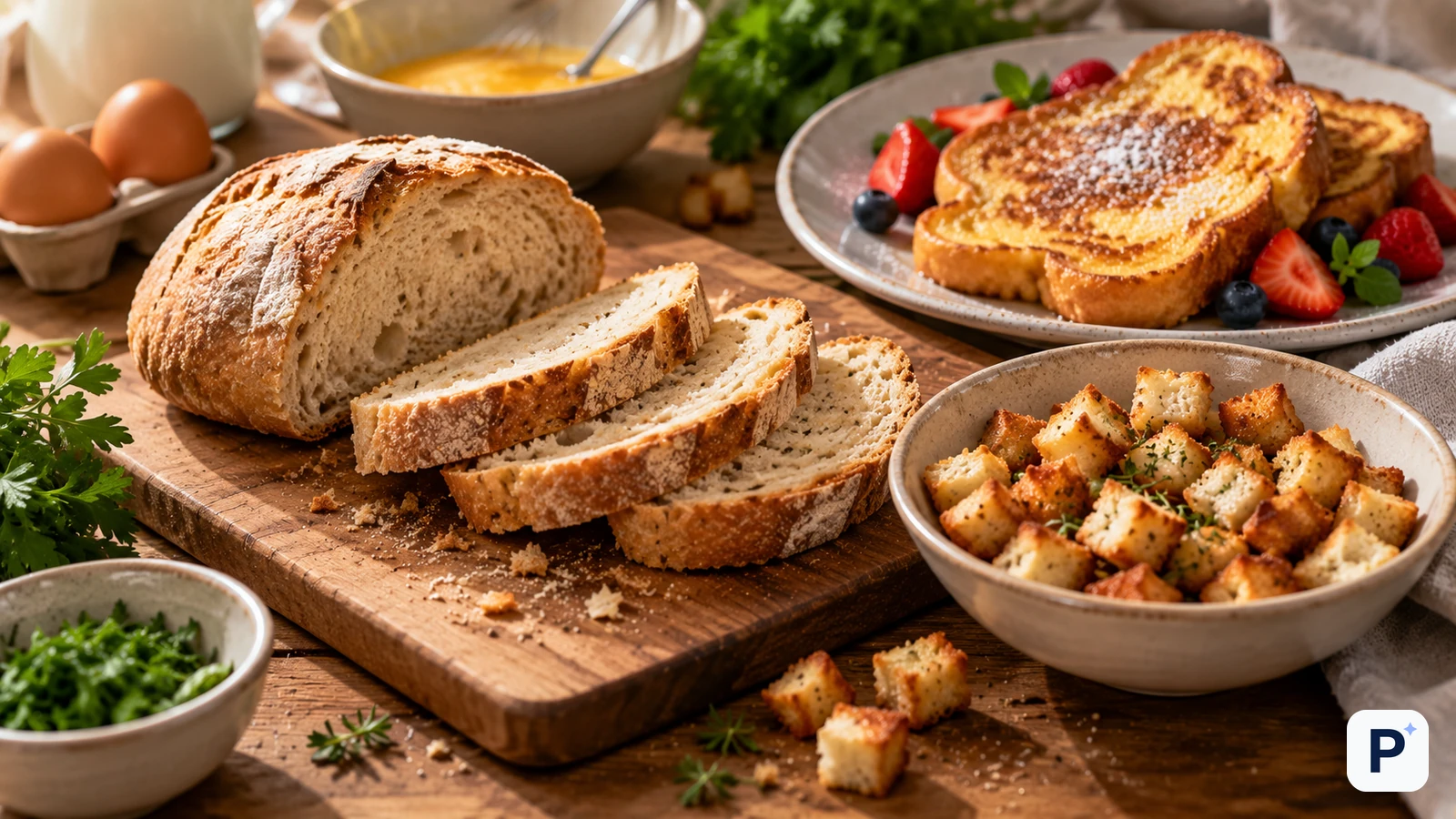
If you want to use the bread straight away, make croutons.
Cut the bread into cubes or smaller pieces, toss them with a little olive oil or other cooking oil and add seasoning. Garlic, oregano, basil, herbes de Provence, paprika or simply salt and pepper all work well.
Then toast the bread in the oven, in a frying pan or in an air fryer until it turns golden and crisp. Stale bread is ideal for this, because it contains less moisture than fresh bread. That's why it crisps up quickly.
You can use croutons in:
- tomato soup,
- a cream soup,
- a salad,
- scrambled eggs,
- fried eggs,
- bakes.
You can also make larger slices instead of cubes. Brush them with olive oil, add cheese, tomatoes, vegetables or leftover meat and bake. Suddenly an ordinary slice of stale bread becomes supper.
2. French Toast
Stale bread is excellent for French toast, because it soaks up the egg mixture so well.
In the basic version all you need is an egg, a little milk and some slices of bread. You dip the slices in the mixture, then fry them in a pan with a little butter or oil.
For a sweet version you can add:
- cinnamon,
- sugar,
- honey,
- fruit,
- yoghurt,
- peanut butter.
For a savoury version:
- cheese,
- ham,
- tomatoes,
- spinach,
- mushrooms,
- chives.
This is one of those cases where a stale product can work better than a fresh one. Drier bread soaks up the egg mixture but doesn't fall apart straight away.
3. Homemade Breadcrumbs
If you have more dry bread, instead of making a single dish from it you can prepare something to use later.
The bread needs to be completely dry. If it's still soft in the middle, you can dry it out further in the oven, then, once it has cooled, grind it in a blender or food processor.
You can later use homemade breadcrumbs for:
- coating cutlets,
- coating fish,
- coating vegetables,
- beef or pork rissoles,
- meatballs,
- stuffings,
- sprinkling over bakes.
This is a particularly good way to deal with a larger amount of bread that you won't be able to use within a few days. The important thing is that the breadcrumbs are really dry before you store them. Moisture encourages mould.
4. Rissoles and Meatballs
Stale bread can also be part of a main meal, not just a side.
Soaked bread is used, among other things, for rissoles and meatballs. Once combined with meat, egg and seasoning, it helps you get the right texture in the mixture.
You don't need a special bread roll. You can use slices of stale bread, soak them in milk or water, then squeeze them out well before adding them to the mixture.
This is one of the best examples of how a product that is no longer fit to eat in its original form can still be a worthwhile ingredient in another dish.
If you fancy a classic, you can use it in a recipe for juicy rissoles.
5. Savoury Bread Bake
If you have more bread and a few things in the fridge, you can turn it into a full dinner.
Cut the bread into smaller pieces and combine it with whatever you happen to have:
- cheese + vegetables + eggs + milk + bread,
- ham + cheese + tomato + bread,
- chicken + vegetables + sauce + bread.
You can pour an egg mixture with milk or cream over the lot and bake it.
This is a very good way to use up not just bread but other leftovers too. A few slices of bread, a piece of cheese and some vegetables left over from another meal can together make something completely new.
6. Panzanella, a Salad with Stale Bread
Panzanella is an Italian salad in which stale bread is not a random extra. It is one of the main ingredients.
The simplest version is stale bread + tomatoes + olive oil + onion + basil. You can lightly toast the bread first, then combine it with the vegetables. The tomato juice and olive oil soak into the bread, so a dry slice becomes part of the whole dish.
You can throw in cucumber, pepper, olives, mozzarella or other ingredients you have in the fridge. It's a good example of cooking by the rule: first check what you have, and only then look for a recipe.
7. Wodzionka and Other Simple Soups
Stale bread can also be the base of a soup.
One Polish example is wodzionka (a simple Silesian bread soup), especially associated with Silesia. Its foundation is stale bread, garlic, fat and hot water or stock. It's a very simple example of a cuisine that makes use of a product that is no longer fresh, rather than throwing it away.
Stale bread can also be used as an addition to other soups. Instead of classic croutons, you can drop larger pieces of toasted bread into the bowl. They work particularly well with thick soups, cream soups and one-pot dishes.
8. Bread Pudding
If you fancy something sweet, stale bread can go in the oven.
Bread pudding is made from bread soaked in a mixture of milk, eggs and sugar. You can add cinnamon, vanilla, apples, bananas, raisins, nuts or pieces of chocolate.
The bread absorbs the mixture and, once baked, creates a soft centre with a browned surface. It's a good way to use up a larger amount of bread at once. You can treat it as a dessert or a sweet breakfast.
9. Torrijas, the Spanish Version of French Toast
If plain French toast has started to bore you, you can make the Spanish version.
Torrijas are also based on bread soaked in milk and egg. They often include cinnamon and sugar, and the finished slices can be served with various toppings depending on the recipe.
From the point of view of not wasting food, though, something else matters most: dry bread gets a second use. You don't need to buy special ingredients. In the basic version, the things many people already have at home are enough.
10. Breadcrumbs for Bakes
You don't have to use stale bread only for coating.
Finely ground bread can be used as a crisp layer on top of a bake. Mix the breadcrumbs with a little olive oil, herbs and seasoning, then sprinkle them over the dish before it goes into the oven.
Once baked, a crisp layer forms that goes well with pasta, vegetables, potatoes or meat bakes. It's a particularly good idea if you only have a few slices and don't want to make a large batch of breadcrumbs.
11. Cheese on Toast as a Quick Supper
Not every way of using up stale bread has to be complicated.
You can spread a slice with butter or olive oil, add cheese and a few toppings, then bake it. For this you can use:
- tomato,
- onion,
- mushrooms,
- pepper,
- ham,
- leftover roast chicken,
- pesto.
It's essentially the same mechanism that works when you cook with leftovers: you take a base, add whatever is left in the fridge, and create a new dish.
12. Stale Bread as a Stuffing Ingredient
If you're making a stuffing for vegetables, pancakes, dumplings or other dishes, a little soaked bread can help bind the ingredients together.
You can use it in a meat or vegetable stuffing, among other things. So you don't have to think of stale bread as something you can only use as a slice. Once ground or soaked, it simply becomes another ingredient.
13. What to Do with a Really Large Amount of Bread?
If you have a few slices left, choose one dish. If almost a whole loaf is left, it's better to think of several uses.
You can:
- turn some of it into breadcrumbs,
- cut some into croutons,
- use some for French toast,
- freeze some, if it's still good and you want to keep it for later.
You don't have to do everything in one day. What matters more is not waiting another week until the bread goes from "stale" to "mouldy".
You Can Also Freeze Stale Bread
The best way to cut down on wasting bread starts before it even turns stale.
If you know you won't eat the whole loaf, you can freeze some of it in advance. The most convenient thing is to divide the bread into portions or slices, so you can later take out exactly as much as you need.
Freezing won't keep bread in perfect condition indefinitely, but it does significantly extend how long it stays good to eat. You can later use the slices in a toaster or prepare them in the way recommended for that particular type of bread.
You can read more about storing bread in our article on how to store bread so it doesn't go mouldy or stale.
How to Decide Quickly What to Do with Stale Bread?
You don't need to look for a specific recipe every time. Just take a look at how much bread is left:
- A few slices? Make croutons, French toast or baked cheese on toast.
- Half a loaf? Make breadcrumbs, a bread bake or bread pudding.
- Stale bread + dinner leftovers? Make a bake, croutons, or use the bread as part of a new dish.
- Stale bread + eggs? French toast or a bake.
- Stale bread + tomatoes + olive oil? Panzanella.
- Stale bread + minced meat? Rissoles or meatballs.
This way you don't need a ready-made recipe for every situation. It's enough to know what stale bread can be useful for.
Most Important: Don't Confuse Going Stale with Going Off
Going stale in itself doesn't mean the bread has to be thrown away. It is above all a change in its texture. The bread loses its softness and freshness, but it can still be used as an ingredient in another dish.
Mould is a different matter. If you spot it, don't try to cut off only the visible piece. The bread should be thrown away whole.
It's also not worth judging mouldy bread by sniffing it up close. Food safety authorities recommend not smelling mouldy products, because mould spores can be harmful if inhaled.
This is one of those situations where saving food should not mean trying to rescue a product that is no longer safe.
Bread Doesn't Have to Be Fresh to Be Good
Stale bread has one big advantage: you can change its role.
- No longer the best for a sandwich? Make croutons.
- Don't fancy croutons? Make French toast.
- Got too much of it? Make breadcrumbs.
- Got a few things in the fridge? Make a bake.
- Got tomatoes and olive oil? Make panzanella.
- Fancy something sweet? Bread pudding.
It's exactly these simple swaps that help cut down on throwing food away. You don't have to use every product in precisely the way it was bought.
Fresh bread is something to eat as bread. Stale bread can be an ingredient. And once you start looking at leftovers this way, it turns out that far fewer things in the kitchen are really fit only for the bin.
PantryOS can help at an earlier stage too. If you can see what you have at home and which products are worth using first, it's easier to decide what to do before food gets forgotten.